
Events
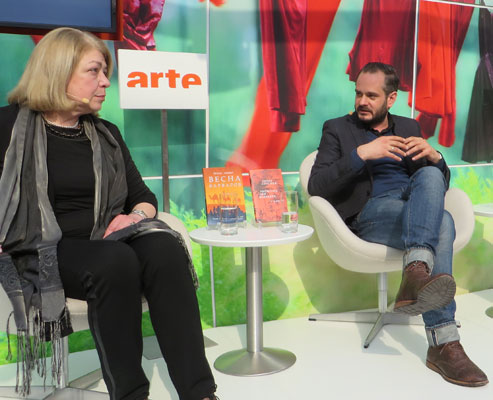
13.03.2015, 1:00 PM LITRIX.DE AT THE LEIPZIG BOOK FAIR 2015
Leipzig
Gutleutstraße 8-12
60329 Frankfurt am Main
ARTE Stand, Glass Atrium, Gallery, Stand 11
In his successful debut “Frühling der Barbaren (The Barbarians’ Spring)” in 2013, Jonas Lüscher uses his powerful eloquence to set off a fictitious stock market crash right in the middle of the riotous wedding celebrations involving members of London’s financial jetset in a Tunisian oasis resort. Lüscher’s bitterly angry novella was published in 2014 in Russia, translated by Maria Zorkaja and funded by Pro Helvetia and Litrix.de. It was very well received there. The author and his translator went on a book tour in Russia and Belarus, the book hot off the press in their luggage. “It was not an easy time for a tour of Russia”, said Lüscher after his return. In Leipzig he and Maria Zorkaja will be discussing the impressions and experiences of their tour, but also the Russian interpretations of the book.
We would also like to draw your attention to numerous events hosted by the Goethe-Institut.
Jonas Lüscher’s novella Frühling der Barbaren [Spring of the barbarians] was published by Ripol in Moscow in the Russian translation of Maria Zorkaya. Shortly thereafter, author and translator embarked on a reading tour, beginning in Petrozavodsk, passing through St. Petersburg, Archangelsk and Moscow, and concluding in Rostov-on-Don. “Not an easy time to be travelling in Russia,” remarked Jonas Lüscher, who would gladly go back again.
Not an easy time to be travelling in Russia; the political disturbances are tangible, and the trip is a completely different one than it would have been a year ago. They want to know what I think about the sanctions. They ask me in a taunting, jestful way if I’m not afraid of this trip. An interviewer at Rossiya 2, a public radio station, tries to present me as a representative of the West attempting to export his depraved morals to Russia, and I’m afraid I cut a bad figure. Literature is then the focus during the readings. But here, too, the discussion usually revolves around a political-social interpretation. There is something gratifying and impressive about this, though. An utterly serious interest in literature. An unusually young audience, many students of German literature, many of whom ask clever questions. But then a female student who laments that young writers nowadays write too much about sex.
Many things can hardly be said. Many people don’t want to hear that there is a substantial difference between Russian and German media – and there is, I’m convinced of this ever since this trip – and react very touchily to the issue. You’re caught in a war of words; propaganda can’t be avoided anyway. Many have trouble imagining things differently. A bloc mentality, thinking in categories mistakenly thought to be obsolete, is alarmingly common.
Of course there are those who are different. Liberal intelligentsia. For example, Yuliana, who accompanies me through Saint Petersburg one evening, and points to the weathervane on the spire of the Admiralty building while reciting Mandelstam. But they know they’re a small minority.
Would I go back to Russia again? No question, now more than ever.
(Jonas Lüscher, fall 2014)
We would also like to draw your attention to numerous events hosted by the Goethe-Institut.
Jonas Lüscher’s novella Frühling der Barbaren [Spring of the barbarians] was published by Ripol in Moscow in the Russian translation of Maria Zorkaya. Shortly thereafter, author and translator embarked on a reading tour, beginning in Petrozavodsk, passing through St. Petersburg, Archangelsk and Moscow, and concluding in Rostov-on-Don. “Not an easy time to be travelling in Russia,” remarked Jonas Lüscher, who would gladly go back again.
Not an easy time to be travelling in Russia; the political disturbances are tangible, and the trip is a completely different one than it would have been a year ago. They want to know what I think about the sanctions. They ask me in a taunting, jestful way if I’m not afraid of this trip. An interviewer at Rossiya 2, a public radio station, tries to present me as a representative of the West attempting to export his depraved morals to Russia, and I’m afraid I cut a bad figure. Literature is then the focus during the readings. But here, too, the discussion usually revolves around a political-social interpretation. There is something gratifying and impressive about this, though. An utterly serious interest in literature. An unusually young audience, many students of German literature, many of whom ask clever questions. But then a female student who laments that young writers nowadays write too much about sex.
Many things can hardly be said. Many people don’t want to hear that there is a substantial difference between Russian and German media – and there is, I’m convinced of this ever since this trip – and react very touchily to the issue. You’re caught in a war of words; propaganda can’t be avoided anyway. Many have trouble imagining things differently. A bloc mentality, thinking in categories mistakenly thought to be obsolete, is alarmingly common.
Of course there are those who are different. Liberal intelligentsia. For example, Yuliana, who accompanies me through Saint Petersburg one evening, and points to the weathervane on the spire of the Admiralty building while reciting Mandelstam. But they know they’re a small minority.
Would I go back to Russia again? No question, now more than ever.
(Jonas Lüscher, fall 2014)