13.03.2015, 4:00 PM
LITRIX.DE AT THE LEIPZIG BOOK FAIR 2015
Leipzig
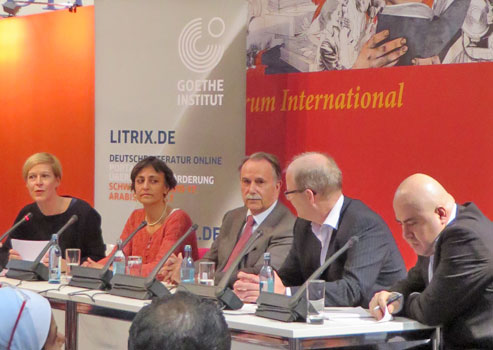
Panel discussion with Leila Chammaa, Kersten Knipp, Klaus-Dieter Lehmann and Loay Mudhoon
Moderator: Anne-Bitt Gerecke, Goethe-Institut
Culture and art reflect not only processes of political and social change; they are an intrinsic part of that change. But what impact has the Arab Spring concretely had on the cultural sector? How have these political upheavals affected the literary and publishing world and also reading habits? How can international cultural institutions assist these processes of change? A panel will discuss these issues in an event organized in conjunction with the new Litrix focus on the “Arab world”, a program the Goethe-Institut sponsors for translations of German language books into Arabic and to promote literary exchange. Participants: Leila Chammaa, translator and literary agent, Kersten Knipp, a freelance journalist and expert on Arabic language and culture, Loay Mudhoon, editorial director of “Qantara.de - Dialogue with the Islamic World”, and Klaus-Dieter Lehmann, President of the Goethe-Institut.
We would also like to draw your attention to numerous events hosted by the Goethe-Institut.
Article:
Literature anticipated the upheavals
How has the Arab Spring affected the literary world - and vice versa? Participants of the panel: “The book market and literature after the upheaval in the Arab world” discussed this question and many others at the Leipzig Book Fair.
How has the Arab Spring affected the cultural and literary world? What role did the authors and intellectuals play in the upheaval? Participants of the Leipzig Book Fair panel included: Loay Mudhoon, editorial director of "Qantara.de - Dialogue with the Islamic World", Leila Chammaa, translator and founder of the literary agency Alif, freelance journalist Kersten Knipp, and Klaus-Dieter Lehmann, president of the Goethe-Institut. The Goethe-Institut promotes literary exchange and the translation of German books into Arabic through Litrix’s new special focus, “Arabic World,” which runs through 2017.
Anne-Bitt Gerecke, the director of Litrix, noted straightaway that we hardly ever hear anything about authors and intellectuals in the Arab world; instead the media is focused on the so-called “Islamic State.” But how are the literati faring in the Arab countries today?
Leila Chammaa was recently in Cairo which is still considered the most important cultural center of the Arab world. During her conversations, she noted grievances were aired covertly: the new government is endangering freedom of expression and journalists are no longer safe in the country: in early November 2014, Alain Gresh, editor of “Le Monde,” was arrested with two Egyptian colleagues at a café in Cairo. A second major problem has to do with the poverty in the country.
“You can feel the stagnation growing with each visit,” reported Loay Mudhoon. “Freedom of the press and freedom of intellectuals are being severely restricted. The government is trying to create a new ruler’s narrative. “It is very difficult and often dangerous to rebel. Moreover, many cultural workers had supported the takeover of the military, explained Mudhoon, “and now they must deal with this accusation.”
Kersten Knipp broadened the conversation with a view to Syria. The situation in this civil war is archaic, many artists and intellectuals have long since left the country. He also fears this could happen in Egypt. Developments in the Sinai, where an offshoot of the “Islamic State” has grown, have occurred partly as a reaction to strong pressures within Egyptian society and this has created a climate of rage and radicalism.
How can cultural work effect change in the region given this context? Klaus-Dieter Lehmann, president of the Goethe-Institut, described cultural workers during the upheaval in 2011 as being creative and cited the Tahrir Lounge at the Goethe-Institut in Cairo as an example: “Of course people were afraid back then, too, but they carved out free spaces for themselves and with it their own identity.” At the moment, however, it is starting to look as if they have not been successful. Not even in Libya, where Lehmann had met strong and creative women's groups: “They have all been silenced. The only hope at the moment is in Tunisia.”
The most heated discussion revolved around the role literature played during the Arab Spring. Kersten Knipp mentioned a few books that have also been very popular in Europe, including “Taxi” by Khaled al-Khamissy and “The Yacoubian Building” by Alaa al Aswany. According to Knipp, “Taxi revealed many of the ills of Egyptian daily life, Aswany described the rampant corruption and lack of opportunities. Early on, the Algerian author Yasmina Khadra had described a culture of violence and lack of hope. The journalist doubted whether these authors had any real political clout.
Leila Chammaa argued that the incipient stages of revolutionary thought could be traced to a much earlier time. A sure indication: authors were frequently being arrested in all of the Arab countries. “The writers basically anticipated the revolutions, for example, Syria in the 1990s. Taboo subjects were being discussed, such as the massacre in Hama under Hafez al-Assad,” said Chammaa. Loay Mudhoon also noted that culture always is a seismograph of change. With an eye on literature, Kersten Knipp also introduced a valuable, though barely recognized genre— Arabic nonfiction: “There is so much important information in them! Political scientists and sociologists in the Arab world are in no way inferior to western scientists.”
Anne-Bitt Gerecke asked which work would serve as a good introduction to Arabic literature. Leila Chammaa answered: One must first recognize that there are common and unifying elements. People in the West often display a certain arrogance. “We are all human, we have similar feelings, have a similar foundation. That is a good basis for understanding.” Loay Mudhoon agreed: of course, the West benefits from the Arab world. “This knowledge will help us to understand the complexity of the world as a whole.”
Klaus-Dieter Lehmann added: “Isolation is absolutely the wrong path.” Having an influx of new ideas is important, as is the opportunity to reflect on these ideas - in both directions. Programs like Litrix.de are crucial. Litrix.de's current special focus on the Arabic World helps translators further their education and supports translation. Local programs are also important, such as Cairo Short Stories which supports Egyptian authors.
Author
Christopher Resch lives and works as a freelance journalist in Leipzig. He writes mainly about society, culture and dialogue with and in the Arabic world.
Moderator: Anne-Bitt Gerecke, Goethe-Institut
Culture and art reflect not only processes of political and social change; they are an intrinsic part of that change. But what impact has the Arab Spring concretely had on the cultural sector? How have these political upheavals affected the literary and publishing world and also reading habits? How can international cultural institutions assist these processes of change? A panel will discuss these issues in an event organized in conjunction with the new Litrix focus on the “Arab world”, a program the Goethe-Institut sponsors for translations of German language books into Arabic and to promote literary exchange. Participants: Leila Chammaa, translator and literary agent, Kersten Knipp, a freelance journalist and expert on Arabic language and culture, Loay Mudhoon, editorial director of “Qantara.de - Dialogue with the Islamic World”, and Klaus-Dieter Lehmann, President of the Goethe-Institut.
We would also like to draw your attention to numerous events hosted by the Goethe-Institut.
Article:
Literature anticipated the upheavals
How has the Arab Spring affected the literary world - and vice versa? Participants of the panel: “The book market and literature after the upheaval in the Arab world” discussed this question and many others at the Leipzig Book Fair.
How has the Arab Spring affected the cultural and literary world? What role did the authors and intellectuals play in the upheaval? Participants of the Leipzig Book Fair panel included: Loay Mudhoon, editorial director of "Qantara.de - Dialogue with the Islamic World", Leila Chammaa, translator and founder of the literary agency Alif, freelance journalist Kersten Knipp, and Klaus-Dieter Lehmann, president of the Goethe-Institut. The Goethe-Institut promotes literary exchange and the translation of German books into Arabic through Litrix’s new special focus, “Arabic World,” which runs through 2017.
Anne-Bitt Gerecke, the director of Litrix, noted straightaway that we hardly ever hear anything about authors and intellectuals in the Arab world; instead the media is focused on the so-called “Islamic State.” But how are the literati faring in the Arab countries today?
Leila Chammaa was recently in Cairo which is still considered the most important cultural center of the Arab world. During her conversations, she noted grievances were aired covertly: the new government is endangering freedom of expression and journalists are no longer safe in the country: in early November 2014, Alain Gresh, editor of “Le Monde,” was arrested with two Egyptian colleagues at a café in Cairo. A second major problem has to do with the poverty in the country.
“You can feel the stagnation growing with each visit,” reported Loay Mudhoon. “Freedom of the press and freedom of intellectuals are being severely restricted. The government is trying to create a new ruler’s narrative. “It is very difficult and often dangerous to rebel. Moreover, many cultural workers had supported the takeover of the military, explained Mudhoon, “and now they must deal with this accusation.”
Kersten Knipp broadened the conversation with a view to Syria. The situation in this civil war is archaic, many artists and intellectuals have long since left the country. He also fears this could happen in Egypt. Developments in the Sinai, where an offshoot of the “Islamic State” has grown, have occurred partly as a reaction to strong pressures within Egyptian society and this has created a climate of rage and radicalism.
How can cultural work effect change in the region given this context? Klaus-Dieter Lehmann, president of the Goethe-Institut, described cultural workers during the upheaval in 2011 as being creative and cited the Tahrir Lounge at the Goethe-Institut in Cairo as an example: “Of course people were afraid back then, too, but they carved out free spaces for themselves and with it their own identity.” At the moment, however, it is starting to look as if they have not been successful. Not even in Libya, where Lehmann had met strong and creative women's groups: “They have all been silenced. The only hope at the moment is in Tunisia.”
The most heated discussion revolved around the role literature played during the Arab Spring. Kersten Knipp mentioned a few books that have also been very popular in Europe, including “Taxi” by Khaled al-Khamissy and “The Yacoubian Building” by Alaa al Aswany. According to Knipp, “Taxi revealed many of the ills of Egyptian daily life, Aswany described the rampant corruption and lack of opportunities. Early on, the Algerian author Yasmina Khadra had described a culture of violence and lack of hope. The journalist doubted whether these authors had any real political clout.
Leila Chammaa argued that the incipient stages of revolutionary thought could be traced to a much earlier time. A sure indication: authors were frequently being arrested in all of the Arab countries. “The writers basically anticipated the revolutions, for example, Syria in the 1990s. Taboo subjects were being discussed, such as the massacre in Hama under Hafez al-Assad,” said Chammaa. Loay Mudhoon also noted that culture always is a seismograph of change. With an eye on literature, Kersten Knipp also introduced a valuable, though barely recognized genre— Arabic nonfiction: “There is so much important information in them! Political scientists and sociologists in the Arab world are in no way inferior to western scientists.”
Anne-Bitt Gerecke asked which work would serve as a good introduction to Arabic literature. Leila Chammaa answered: One must first recognize that there are common and unifying elements. People in the West often display a certain arrogance. “We are all human, we have similar feelings, have a similar foundation. That is a good basis for understanding.” Loay Mudhoon agreed: of course, the West benefits from the Arab world. “This knowledge will help us to understand the complexity of the world as a whole.”
Klaus-Dieter Lehmann added: “Isolation is absolutely the wrong path.” Having an influx of new ideas is important, as is the opportunity to reflect on these ideas - in both directions. Programs like Litrix.de are crucial. Litrix.de's current special focus on the Arabic World helps translators further their education and supports translation. Local programs are also important, such as Cairo Short Stories which supports Egyptian authors.
Author
Christopher Resch lives and works as a freelance journalist in Leipzig. He writes mainly about society, culture and dialogue with and in the Arabic world.
Cooperation basis e.V.
13.03.2015, 4:00 PM
Gutleutstraße 8-12
60329 Frankfurt am Main
Forum International, Hall 4, Stand C 503