Book World
Literary Translators and AI
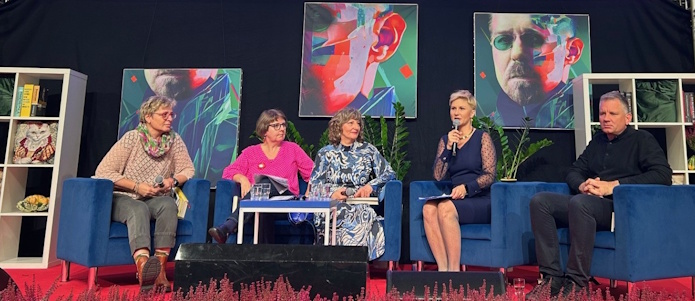
Translators are also authors: Can AI replace literary translators?
by Marta Gruszecka
AI is evolving at a rapid pace. How will it continue to evolve in 2026, and what are its potential uses? Teams from the Goethe-Institut and the Polish Translators' Association have been testing how AI copes with literary translation.
The inception of AI dates back to the 1950s. In 1956, a high-profile conference (attended by John McCarthy, Marvin Minsky, Nathaniel Rochester, Claude Shannon, and others) was held at Dartmouth College with the intention of defining AI, its intended use, and the paths it might take as it evolves in the future. At the time, nobody could have imagined the range of applications, or the level of efficiency this man-made instrument would achieve within seventy-years.
Translators vs AI – or "Translators face-off against AI"
Already in 2025, the potential of AI and, above all, the ways in which it is being used in business, logistics, communication, medicine, science, as well as in the arts and culture continues to amaze us. Some uses of it are particularly noteworthy. For example, AI co-curated the Unsound Festival, which is one of the most prominent music festivals in Poland, and at Patchlab-Festival for digital art, where it was employed to establish a person's character based solely on their photo.
Almost every smartphone has access to AI which can be used, for example, to optimize or retouch images, write texts, or do homework. AI also can translate any number of languages. Will this function lead to the disappearance of translation as a profession, i.e. can translators compete with AI, especially given that AI operates at a speed no human can match?
The Goethe-Institut and the Polish Translators' Association organized the "Translators face-off against AI" event as part of the 28th Krakow International Book Fair (October 23-26, 2025). The translators Ewa Mikulska-Frindo, Katarzyna Łakomik, Mark Ordon, and Anna Wziątek rose to the challenge. The task was to translate an excerpt from the novels: Lebensversicherung (Life Insurance) by Kathrin Bach, Alle Farben von Licht (All Colors of Light) by Annika Scheffel, Das Narrenschiff (The Ship of Fools) by Christoph Hein, and Das Herz von Kamp-Cornell (The Heart of Kamp-Cornell) by Susan Kreller, all of which are books featured by Litrix.de during its current focus on translations into Polish. AI was fed the same text excerpts as the translators. Who can translate better? Humans or machines? Are machines able to convey literary nuances at the same level of expertise as experienced translators? Are literary translators still irreplaceable?
How can we define "literary translation"?
"For me, it mainly has to do with the ability to convey not only the content, but also stylistic and artistic subtleties: this includes cultural contexts, atmosphere, emotions, and the meaning hidden between the lines. My goal is to reproduce the rhythm, intonation, and the richness of stylistic devices that exist in the original, while living in the target language," explains Anna Wziątek. Her colleague Katarzyna Łakomik added: "Literary translation consists of reproducing the author's distinct style—a subject matter that is difficult to grasp—in such a way that readers in the target language will perceive it in the same way the text is perceived in the original. This distinguishes literary translation from all other types of translation that I usually deal with, where the primary concern is to accurately convey the information content in the target language. Here, however, the translator's work goes beyond the purely factual communication of information."
Ewa Mikulska-Frindo, another participant in the "Translators face-off against AI" session, summed it up as follows: "The motto of our literary translators' association [...] is ‘The translator is also an author’. Literary translation, therefore, is an art form. The translator writes a text in the target language which makes them a co-author. Their task is not only to faithfully reproduce the content, but also to preserve the aesthetics, style, and emotional tension of the original. For me translating is a passion, a challenge, and a joy, especially when I succeed in conveying the spirit of the German-language original in Polish."
Errors and omissions
Following this line of thought, AI does not presently pose a threat to literary translations. That said, translators have expressed cautious optimism about the future of translating: "We cannot predict what the future will bring. Everything is possible! Ten years ago, nobody would ever have expected that we'd now be dealing with such a high level of sophistication in AI. At the moment, however, it still cannot deal well with this particular form of translation, [...] Some information, even entire passages, are notoriously omitted by AI—not to mention the reproduction of emotions," Katarzyna Łakomik added. Anna Wziątek agreed: "As long as AI cannot read ‘between the lines’, it cannot cope with the stylistic devices or atmosphere of the text, and I do not see it as competition for my work."
Is AI gouging prices? Will the evolution of AI change translation as a profession in the near future? "Translators may become a kind of creative assistant, somebody who, thanks to their sensitivity for language, gives the machine translation a 'human face'. Unfortunately, this can lead to a lower volume of contracts, tight deadlines for the respective project, and a lower fee," noted Ewa Mikulska-Frindo. "The market for non-literary translation is already largely based on post-editing, i.e., basically proofreading machine or AI translations. Some translators intentionally avoid this kind of work or [...] even change sectors. This is because translation agencies naturally pay lower fees for proofreading than for their own translations,” added Katarzyna Łakomik.
Keep your eyes open when using AI The use of AI in translation has been the subject of intense debate, though opinions are divided on the matter, as Katarzyna Łakomik notes: "I see AI as a tool that some translators will use to support their work in the future. We all feel a slight unease about it; some use it, others don't. Some talk openly about it, others are afraid of being criticized for it [...] it's very individual. This is one reason why many translators do not resort to AI for assistance. They want to avoid the "originality effect," i.e., a cognitive error that consists in considering the first version, i.e., the first suggestion made by AI, to be the best version; perhaps even the only correct version. Those who are aware of this would have to constantly second guess AI's suggestions, and it would be difficult to do so with the same amount of vigilance each time."
When I asked about the specific challenges of working with AI, Katarzyna Łakomik elaborated further: "In literary translation, I use AI for research and sometimes to overcome a block when I can't find a satisfactory solution. Then I describe the context and the specific problem of finding an equivalent in the target language and ask AI to suggest other versions [...]."
Knowledge-based translation
Nonetheless, the translator emphasized that AI can only be trusted to a limited extent: "AI has to be checked, double-checked, and checked again. I have to be smarter than it in the respective field or subject area to determine whether AI is hallucinating or not. If I lack the relevant expertise myself, the AI data must be checked with the aid of specialized works on the topic. [...] I am particularly concerned here with scientific publications, specialist and popular science literature. We have to immerse ourselves in the respective world of knowledge or life so that the language we use to describe these worlds appears natural to the reader, as if we were the authors, and thus specialists in the respective field."
Ewa Mikulska-Frindo also had something to say about the uses of AI: "AI often suggests different solutions to a particular problem. But I am the one who decides whether to use the suggestion or not, and I am the one who does the choosing. I'm very cautious about that [...] and check the credibility of the sources." In her opinion, the use of AI makes translation easier. However, it is important to be cautious because your own creativity can suffer from the sheer number of results. Anna Wziątek also advocated for using AI: "I use it occasionally when I can't decide on a specific solution or am unsure how to solve a linguistic problem. Then I turn to AI and insert the relevant fragment into the translation tool. Most of the time, it's more amusing than helpful, but sometimes these ‘artificial’ translations lead to the solution I had been searching for."
AI smooths, repeats, and simplifies dialogue
So, how did the "Translators face-off against AI" match ultimately turn out? Humans won hands down! When comparing the original excerpt from Kathrin Bach's novel Lebensversicherung (Life Insurance) with the translation by the full version of DeepL, it became clear that AI had particular difficulty with onomatopoeic text and dialogue that had been written in dialect. The former was not translated at all and simply left in the original. The dialogue seemed wooden. Moreover, there were countless inaccuracies, some grammatical errors, clumsy phrasing, and loan translations. Furthermore, the text was smoothed out even though it was not necessary. Another major problem was the repetitions, which sound natural in German but are irritating in Polish. "In Polish, you have to make a real effort to avoid repetitions,” explained Ewa Mikulska-Frindo, adding that the novel Lebensversicherung, which she translated in competition with AI, was not demanding linguistically. "The author refrained from using complicated wordplay, stylistic devices, cultural or intertextual references. As a translator, the novel was not too much of a challenge for me.”
Time will tell how the cooperation between translators and AI will evolve. For now, we can only hope that AI will provide expert support and that translators will remain critical and—as the participants in the "Translators face-off against AI" session repeatedly emphasized—creative in their use of it.
Marta Gruszecka is a Polish journalist who writes for Poland's largest daily newspaper, "Gazeta Wyborcza," among others; and is a cat lover and marathon runner who never gives up. Translated from German by Zaia Alexander
The inception of AI dates back to the 1950s. In 1956, a high-profile conference (attended by John McCarthy, Marvin Minsky, Nathaniel Rochester, Claude Shannon, and others) was held at Dartmouth College with the intention of defining AI, its intended use, and the paths it might take as it evolves in the future. At the time, nobody could have imagined the range of applications, or the level of efficiency this man-made instrument would achieve within seventy-years.
Translators vs AI – or "Translators face-off against AI"
Already in 2025, the potential of AI and, above all, the ways in which it is being used in business, logistics, communication, medicine, science, as well as in the arts and culture continues to amaze us. Some uses of it are particularly noteworthy. For example, AI co-curated the Unsound Festival, which is one of the most prominent music festivals in Poland, and at Patchlab-Festival for digital art, where it was employed to establish a person's character based solely on their photo.
Almost every smartphone has access to AI which can be used, for example, to optimize or retouch images, write texts, or do homework. AI also can translate any number of languages. Will this function lead to the disappearance of translation as a profession, i.e. can translators compete with AI, especially given that AI operates at a speed no human can match?
The Goethe-Institut and the Polish Translators' Association organized the "Translators face-off against AI" event as part of the 28th Krakow International Book Fair (October 23-26, 2025). The translators Ewa Mikulska-Frindo, Katarzyna Łakomik, Mark Ordon, and Anna Wziątek rose to the challenge. The task was to translate an excerpt from the novels: Lebensversicherung (Life Insurance) by Kathrin Bach, Alle Farben von Licht (All Colors of Light) by Annika Scheffel, Das Narrenschiff (The Ship of Fools) by Christoph Hein, and Das Herz von Kamp-Cornell (The Heart of Kamp-Cornell) by Susan Kreller, all of which are books featured by Litrix.de during its current focus on translations into Polish. AI was fed the same text excerpts as the translators. Who can translate better? Humans or machines? Are machines able to convey literary nuances at the same level of expertise as experienced translators? Are literary translators still irreplaceable?
How can we define "literary translation"?
"For me, it mainly has to do with the ability to convey not only the content, but also stylistic and artistic subtleties: this includes cultural contexts, atmosphere, emotions, and the meaning hidden between the lines. My goal is to reproduce the rhythm, intonation, and the richness of stylistic devices that exist in the original, while living in the target language," explains Anna Wziątek. Her colleague Katarzyna Łakomik added: "Literary translation consists of reproducing the author's distinct style—a subject matter that is difficult to grasp—in such a way that readers in the target language will perceive it in the same way the text is perceived in the original. This distinguishes literary translation from all other types of translation that I usually deal with, where the primary concern is to accurately convey the information content in the target language. Here, however, the translator's work goes beyond the purely factual communication of information."
Ewa Mikulska-Frindo, another participant in the "Translators face-off against AI" session, summed it up as follows: "The motto of our literary translators' association [...] is ‘The translator is also an author’. Literary translation, therefore, is an art form. The translator writes a text in the target language which makes them a co-author. Their task is not only to faithfully reproduce the content, but also to preserve the aesthetics, style, and emotional tension of the original. For me translating is a passion, a challenge, and a joy, especially when I succeed in conveying the spirit of the German-language original in Polish."
Errors and omissions
Following this line of thought, AI does not presently pose a threat to literary translations. That said, translators have expressed cautious optimism about the future of translating: "We cannot predict what the future will bring. Everything is possible! Ten years ago, nobody would ever have expected that we'd now be dealing with such a high level of sophistication in AI. At the moment, however, it still cannot deal well with this particular form of translation, [...] Some information, even entire passages, are notoriously omitted by AI—not to mention the reproduction of emotions," Katarzyna Łakomik added. Anna Wziątek agreed: "As long as AI cannot read ‘between the lines’, it cannot cope with the stylistic devices or atmosphere of the text, and I do not see it as competition for my work."
Is AI gouging prices? Will the evolution of AI change translation as a profession in the near future? "Translators may become a kind of creative assistant, somebody who, thanks to their sensitivity for language, gives the machine translation a 'human face'. Unfortunately, this can lead to a lower volume of contracts, tight deadlines for the respective project, and a lower fee," noted Ewa Mikulska-Frindo. "The market for non-literary translation is already largely based on post-editing, i.e., basically proofreading machine or AI translations. Some translators intentionally avoid this kind of work or [...] even change sectors. This is because translation agencies naturally pay lower fees for proofreading than for their own translations,” added Katarzyna Łakomik.
Keep your eyes open when using AI The use of AI in translation has been the subject of intense debate, though opinions are divided on the matter, as Katarzyna Łakomik notes: "I see AI as a tool that some translators will use to support their work in the future. We all feel a slight unease about it; some use it, others don't. Some talk openly about it, others are afraid of being criticized for it [...] it's very individual. This is one reason why many translators do not resort to AI for assistance. They want to avoid the "originality effect," i.e., a cognitive error that consists in considering the first version, i.e., the first suggestion made by AI, to be the best version; perhaps even the only correct version. Those who are aware of this would have to constantly second guess AI's suggestions, and it would be difficult to do so with the same amount of vigilance each time."
When I asked about the specific challenges of working with AI, Katarzyna Łakomik elaborated further: "In literary translation, I use AI for research and sometimes to overcome a block when I can't find a satisfactory solution. Then I describe the context and the specific problem of finding an equivalent in the target language and ask AI to suggest other versions [...]."
Knowledge-based translation
Nonetheless, the translator emphasized that AI can only be trusted to a limited extent: "AI has to be checked, double-checked, and checked again. I have to be smarter than it in the respective field or subject area to determine whether AI is hallucinating or not. If I lack the relevant expertise myself, the AI data must be checked with the aid of specialized works on the topic. [...] I am particularly concerned here with scientific publications, specialist and popular science literature. We have to immerse ourselves in the respective world of knowledge or life so that the language we use to describe these worlds appears natural to the reader, as if we were the authors, and thus specialists in the respective field."
Ewa Mikulska-Frindo also had something to say about the uses of AI: "AI often suggests different solutions to a particular problem. But I am the one who decides whether to use the suggestion or not, and I am the one who does the choosing. I'm very cautious about that [...] and check the credibility of the sources." In her opinion, the use of AI makes translation easier. However, it is important to be cautious because your own creativity can suffer from the sheer number of results. Anna Wziątek also advocated for using AI: "I use it occasionally when I can't decide on a specific solution or am unsure how to solve a linguistic problem. Then I turn to AI and insert the relevant fragment into the translation tool. Most of the time, it's more amusing than helpful, but sometimes these ‘artificial’ translations lead to the solution I had been searching for."
AI smooths, repeats, and simplifies dialogue
So, how did the "Translators face-off against AI" match ultimately turn out? Humans won hands down! When comparing the original excerpt from Kathrin Bach's novel Lebensversicherung (Life Insurance) with the translation by the full version of DeepL, it became clear that AI had particular difficulty with onomatopoeic text and dialogue that had been written in dialect. The former was not translated at all and simply left in the original. The dialogue seemed wooden. Moreover, there were countless inaccuracies, some grammatical errors, clumsy phrasing, and loan translations. Furthermore, the text was smoothed out even though it was not necessary. Another major problem was the repetitions, which sound natural in German but are irritating in Polish. "In Polish, you have to make a real effort to avoid repetitions,” explained Ewa Mikulska-Frindo, adding that the novel Lebensversicherung, which she translated in competition with AI, was not demanding linguistically. "The author refrained from using complicated wordplay, stylistic devices, cultural or intertextual references. As a translator, the novel was not too much of a challenge for me.”
Time will tell how the cooperation between translators and AI will evolve. For now, we can only hope that AI will provide expert support and that translators will remain critical and—as the participants in the "Translators face-off against AI" session repeatedly emphasized—creative in their use of it.
Marta Gruszecka is a Polish journalist who writes for Poland's largest daily newspaper, "Gazeta Wyborcza," among others; and is a cat lover and marathon runner who never gives up. Translated from German by Zaia Alexander