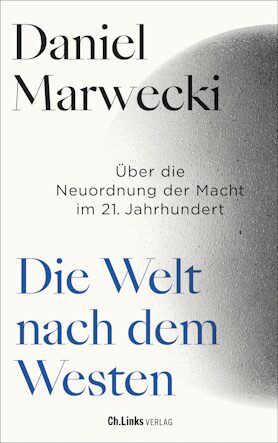
Daniel Marwecki
Die Welt nach dem Westen. Über die Neuordnung der Macht im 21. Jahrhundert
[The World After the West. On the Reorganization of Power in the 21st Century]
- Aufbau Verlag
- Berlin 2025
- ISBN 978-3-96289-239-5
- 288 Pages
- Publisher’s contact details
For this title we provide support for translation into the Polish language (2025 - 2027).
Sample translations
Between the future and the past: Europe’s role in the post-Western world
Apart from Marwecki’s disdain for some European achievements such as the rule of law and individual liberty, his assessment of the post-Western world order is certainly a reasonable one. His perspective from Hong Kong sharpens his sense of reality and acts as a counterweight to “German unworldliness.” The weakening of Germany and Europe, in economic, political and cultural terms, is inevitable in Marwecki’s view. What matters most now is how we deal with it. The decline of former colonial empires, first and foremost Great Britain and France, may be an established fact and even a welcome state of affairs. But what should we think about the rise of actors like China, India and Brazil? Marwecki emphasizes that none of these actors is likely to exercise cultural hegemony the way the “Occident” did, and they certainly won’t give us unwanted lectures on freedom and human rights. The “revolt of the others” and their rise to power will take place in myriad ways, with the East Asian “drive for industrialization,” a robust, export-oriented state capitalism, offering the greatest potential. What China has succeeded in could soon succeed in places like Indonesia as well, in his opinion. But isn’t the economic success of East Asia deeply linked to its culture of the collective? Could Europe learn from this culture – and would it want to?
Marwecki describes the rise of non-Western powers as a story of multiple emancipations. It started in the struggles for independence that culminated in the first wave of decolonization around 1960. Now a “second revolt against the West” is underway, sparked by the wars in Ukraine and Gaza. From the viewpoint of China and its many friends around the world, both conflicts might be unfortunate but they don’t warrant taking sides with the West. And, anyway, who’s the aggressor? Moscow likes to see itself as an advocate of decolonization, fighting in Ukraine against American hegemony and for a multipolar world order. And the Palestinians, for their part, can count on the sympathy of the “Global South” as long as they are exclusively seen as the victims of a “colonial project” by the name of Israel.
In the post-Western world, the moral principles for which Europe is famed or infamous have fallen into disrepute. The United States, too, is realigning itself to this new world or helping to recreate it. This world will be multipolar, highly competitive and if need be militant. Daniel Marwecki emphatically rejects the “sadness” of Europe in the face of this emerging new world.
Translated by David Burnett

By Christoph Bartmann
Christoph Bartmann was director of the Goethe-Institute in Copenhagen, New York and Warsaw. Today he lives and works in Hamburg as a freelance author and critic.
Publisher's Summary
What comes after 300 years of Western dominance?
The world that Europe created in the 19th century has become a world that the West is no longer able to reign over alone. The decline of the West is being followed by the rise of all those who were once dominated by European powers. Countries such as India, South Africa, Brazil, Indonesia and Saudi Arabia have long since ceased to be relegated to the back seat. They find a powerful alternative to economic policy in China. The USA has long been uneasy about the rise of China, with talk of a new Cold War. With Russia, the USA is seeking to close ranks with Europe – which must finally learn to act independently and as a united force.
Political scientist Daniel Marwecki explains the historical background and geopolitical consequences of a shifting world. Beyond alarmism and doom and gloom, his groundbreaking book opens up new perspectives on the global order in the 21st century – which will be very different from the Western order, despite being modeled on it. An important voice of the young scientific generation analyses the tectonics of the present.
(Text: Aufbau Verlag)