18.02.2015, 7:30 PM
Litrix.de is launching its new special-focus Arabic World (2015-2018)
Cairo
With a reading by Ricarda Junge from her novel „Die letzten warmen Tage“ [The last warm days] and a presentation of the special-focus Litrix program at the Cairo International Literature Festival. Cherifa Magdi will offer interesting insights into “German literature and the Arabic book market.” Also featured are the authors Ricarda Junge and Christoph Peters in a conversation about literature and translation.
Since time immemorial, translation has played a central role in the transfer of knowledge and culture between diverse peoples. The Rosetta Stone, for example, helped in deciphering hieroglyphics because the priestly decree was written in two languages and in three types of script. Johann Wolfgang von Goethe focused intensively on the topic of translation and wrote in 1827:
“And thus every translator should be considered a mediator striving to promote this universal exchange and taking it upon himself to make this generalized trade go forward. For whatever may be said of the inadequacy of translation, it remains one of the most essential and most and most worthy activities in the general traffic of the world.”
In order to facilitate the exchange of knowledge and culture between Germany and the Arabic world, the Goethe-Institut’s translation grant program Litrix.de will sponsor translations between the two countries for the next three years.
Litrix.de was launched in 2003, and is an integral part of the “Literature and Translation Program” of the Goethe-Institut headquarters in Munich. Every three years, the program focuses on a specific language. Thus far, Litrix.de has sponsored the translation of approximately 100 titles in the following focus languages: Arabic (2004-05), Chinese (2005-6), Portuguese: Brazil (2007-08), Spanish: Hispano America / Argentina (2009-11) and Russian (2012-14). The Arabic world is once again the special focus from beginning 2015 through 2017.
Litrix’s special focus on the Arabic world 2015-2017 was launched at the end of February in Cairo. The event was held at the Kotob Khan Bookstore with a conversation about translation and the grant program. The evening began with a lecture by Dr. Cherifa Magdi, who provided a historical context to the translation movement from German to Arabic.
In 1835, Egypt founded the first translation academy. Cherifa Magdi noted that French was the source language and that mostly military manuals and scientific writings were being translated at that time. Around 1920, “The Sorrows of Young Werther” by Johann Wolfgang von Goethe was translated into Arabic, and at this time “Faust” was translated as well. “The quantum leap to translating into German took place in the 1960s,” said Magdi Cherifa. Yet, even to this day, there is still a problem with bibliography and lexicography. There continues to be a lack of good, modern German-Arabic dictionaries. “Translators are forced to refer to English or French to research unfamiliar words,” says the translator. Even today, particularly in the areas of psychology and philosophy, works are translated from English and French into Arabic rather than directly from the German. The problem also exists in fiction; of the 14 translations of Hermann Hesse into Arabic, only three were translated directly from the German.
This is where the Litrix grant program comes in. “From the very beginning, the special focus in 2004- 2005 was Arabic, and we are extremely curious to find out what has developed since then,” says Shoshana Liessmann of Litrix.de. It is about promoting literary exchange between Germany and the Arabic world. For the next three years, contemporary German literature will be presented on our Literature Portal www.litrix.de . A jury consisting of Germans and Arabs select the new titles. Each spring and autumn, a jury of German critics draws up a list of new publications in German. After that literary experts from the Arabic jury select ten to twelve titles to be presented during the year on the website. Thus, new titles will continually be presented at www.litrix.de for the next three years.
The jury chooses titles from three categories: Fiction, Nonfiction, and Literature for Children and Young People. Each book featured on the portal includes a detailed book review, a lengthy excerpt of up to 15 pages, author portraits and details about the publishing company in German, English and Arabic respectively. “It is crucial for prospective publishers to get an impression of the language and rhythm of a book,” says Shoshana Liessmann. Through the website, interested publishers can then directly contact the licensing department of the German publishing company to inquire about the translation rights.
Litrix.de grant program will cover the costs of translation into Arabic and subsidizes the cost of the license as well. “We’re hoping, of course, that we will soon see many books translated into Arabic,” says Shoshana Liessmann. But the promotion and exchange program does not stop at translation. Once a book has been translated into Arabic, Litrix.de endeavors, in close cooperation with the various Goethe Institute’s in the region, to bring the Arabic public into direct contact with the German authors and their books, for example, at book fairs in the Arabic world and at readings. “This exchange is very important to us,” says Shoshana Liessmann.
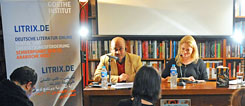
Such an exchange began at the launch of the grant program in Cairo at the Kotob Khan Bookstore. The German author Ricarda Junge read from her novel, “The last warm days,” one of the books featured on Litrix.de. The novel focuses on the divided Germany and narrates what happens to a country when a political system encroaches on family life. “I hope this reading will inspire you to engage with the German language,” said the author to the audience.
What was it like for her to hear her text translated into Arabic? “I feel as if I understand Arabic now,” replied the author and laughed. In fact, during the reading of her text in Arabic, Ricarda Junge rightly noted that a different section was read than she had previously read in German. Translation always entails a transfer into another language, and this means that words will resonate differently, said Shoshana Liessmann. Thus far, two novels by the author Ricarda Junge have been translated into French and Swedish. “I had nothing to do with the translation into French, but in Swedish I had a lively exchange with the translator,” says Ricarda Junge. It was a great experience to work so closely with the translator. Some phrases and idioms simply could not be translated. “During the process, I realized that it becomes a completely different book in translation.”
Goethe once said: “Translators are to be regarded as busy matchmakers who exalt the great loveliness of a half-veiled beauty: They kindle an irresistible longing for the original.” (Johann Wolfgang von Goethe, Maxims and Reflections, 1826)
Amira El Ahl lives and works in Cairo as a journalist and correspondent for the Middle East.
Translated by Zaia Alexander
Since time immemorial, translation has played a central role in the transfer of knowledge and culture between diverse peoples. The Rosetta Stone, for example, helped in deciphering hieroglyphics because the priestly decree was written in two languages and in three types of script. Johann Wolfgang von Goethe focused intensively on the topic of translation and wrote in 1827:
“And thus every translator should be considered a mediator striving to promote this universal exchange and taking it upon himself to make this generalized trade go forward. For whatever may be said of the inadequacy of translation, it remains one of the most essential and most and most worthy activities in the general traffic of the world.”
In order to facilitate the exchange of knowledge and culture between Germany and the Arabic world, the Goethe-Institut’s translation grant program Litrix.de will sponsor translations between the two countries for the next three years.
Litrix.de was launched in 2003, and is an integral part of the “Literature and Translation Program” of the Goethe-Institut headquarters in Munich. Every three years, the program focuses on a specific language. Thus far, Litrix.de has sponsored the translation of approximately 100 titles in the following focus languages: Arabic (2004-05), Chinese (2005-6), Portuguese: Brazil (2007-08), Spanish: Hispano America / Argentina (2009-11) and Russian (2012-14). The Arabic world is once again the special focus from beginning 2015 through 2017.
Litrix’s special focus on the Arabic world 2015-2017 was launched at the end of February in Cairo. The event was held at the Kotob Khan Bookstore with a conversation about translation and the grant program. The evening began with a lecture by Dr. Cherifa Magdi, who provided a historical context to the translation movement from German to Arabic.
In 1835, Egypt founded the first translation academy. Cherifa Magdi noted that French was the source language and that mostly military manuals and scientific writings were being translated at that time. Around 1920, “The Sorrows of Young Werther” by Johann Wolfgang von Goethe was translated into Arabic, and at this time “Faust” was translated as well. “The quantum leap to translating into German took place in the 1960s,” said Magdi Cherifa. Yet, even to this day, there is still a problem with bibliography and lexicography. There continues to be a lack of good, modern German-Arabic dictionaries. “Translators are forced to refer to English or French to research unfamiliar words,” says the translator. Even today, particularly in the areas of psychology and philosophy, works are translated from English and French into Arabic rather than directly from the German. The problem also exists in fiction; of the 14 translations of Hermann Hesse into Arabic, only three were translated directly from the German.
This is where the Litrix grant program comes in. “From the very beginning, the special focus in 2004- 2005 was Arabic, and we are extremely curious to find out what has developed since then,” says Shoshana Liessmann of Litrix.de. It is about promoting literary exchange between Germany and the Arabic world. For the next three years, contemporary German literature will be presented on our Literature Portal www.litrix.de . A jury consisting of Germans and Arabs select the new titles. Each spring and autumn, a jury of German critics draws up a list of new publications in German. After that literary experts from the Arabic jury select ten to twelve titles to be presented during the year on the website. Thus, new titles will continually be presented at www.litrix.de for the next three years.
The jury chooses titles from three categories: Fiction, Nonfiction, and Literature for Children and Young People. Each book featured on the portal includes a detailed book review, a lengthy excerpt of up to 15 pages, author portraits and details about the publishing company in German, English and Arabic respectively. “It is crucial for prospective publishers to get an impression of the language and rhythm of a book,” says Shoshana Liessmann. Through the website, interested publishers can then directly contact the licensing department of the German publishing company to inquire about the translation rights.
Litrix.de grant program will cover the costs of translation into Arabic and subsidizes the cost of the license as well. “We’re hoping, of course, that we will soon see many books translated into Arabic,” says Shoshana Liessmann. But the promotion and exchange program does not stop at translation. Once a book has been translated into Arabic, Litrix.de endeavors, in close cooperation with the various Goethe Institute’s in the region, to bring the Arabic public into direct contact with the German authors and their books, for example, at book fairs in the Arabic world and at readings. “This exchange is very important to us,” says Shoshana Liessmann.
Such an exchange began at the launch of the grant program in Cairo at the Kotob Khan Bookstore. The German author Ricarda Junge read from her novel, “The last warm days,” one of the books featured on Litrix.de. The novel focuses on the divided Germany and narrates what happens to a country when a political system encroaches on family life. “I hope this reading will inspire you to engage with the German language,” said the author to the audience.
What was it like for her to hear her text translated into Arabic? “I feel as if I understand Arabic now,” replied the author and laughed. In fact, during the reading of her text in Arabic, Ricarda Junge rightly noted that a different section was read than she had previously read in German. Translation always entails a transfer into another language, and this means that words will resonate differently, said Shoshana Liessmann. Thus far, two novels by the author Ricarda Junge have been translated into French and Swedish. “I had nothing to do with the translation into French, but in Swedish I had a lively exchange with the translator,” says Ricarda Junge. It was a great experience to work so closely with the translator. Some phrases and idioms simply could not be translated. “During the process, I realized that it becomes a completely different book in translation.”
Goethe once said: “Translators are to be regarded as busy matchmakers who exalt the great loveliness of a half-veiled beauty: They kindle an irresistible longing for the original.” (Johann Wolfgang von Goethe, Maxims and Reflections, 1826)
Amira El Ahl lives and works in Cairo as a journalist and correspondent for the Middle East.
Translated by Zaia Alexander
Cooperation Buchhandlung Kotob Khan
18.02.2015, 7:30 PM