The Leipzig Book Fair 2026 and the Spring Book Season
On Gifts of Time and Gardens of Cooperation
Katrin Schumacher, Chair of the Jury for the 2026 Leipzig Book Fair Prize, has immersed herself in the books from the spring season and shares the literary treasures she has unearthed for us.
Alexander Kluge, Pluriversum, p. 61
When books start corresponding with one another. When one reading acts as a stepping stone to the next, the world gains a framework and stability. In Alexander Kluge's words, we will have arrived in the “Gardens of Cooperation” when this happens. Kluge, who passed away at the end of March 2026, was a trailblazing thinker, whose views were as inclusive as they were rhizomatic. The Gardens of Cooperation describes a world, wherein that which is communally planted and nurtured also will flourish.
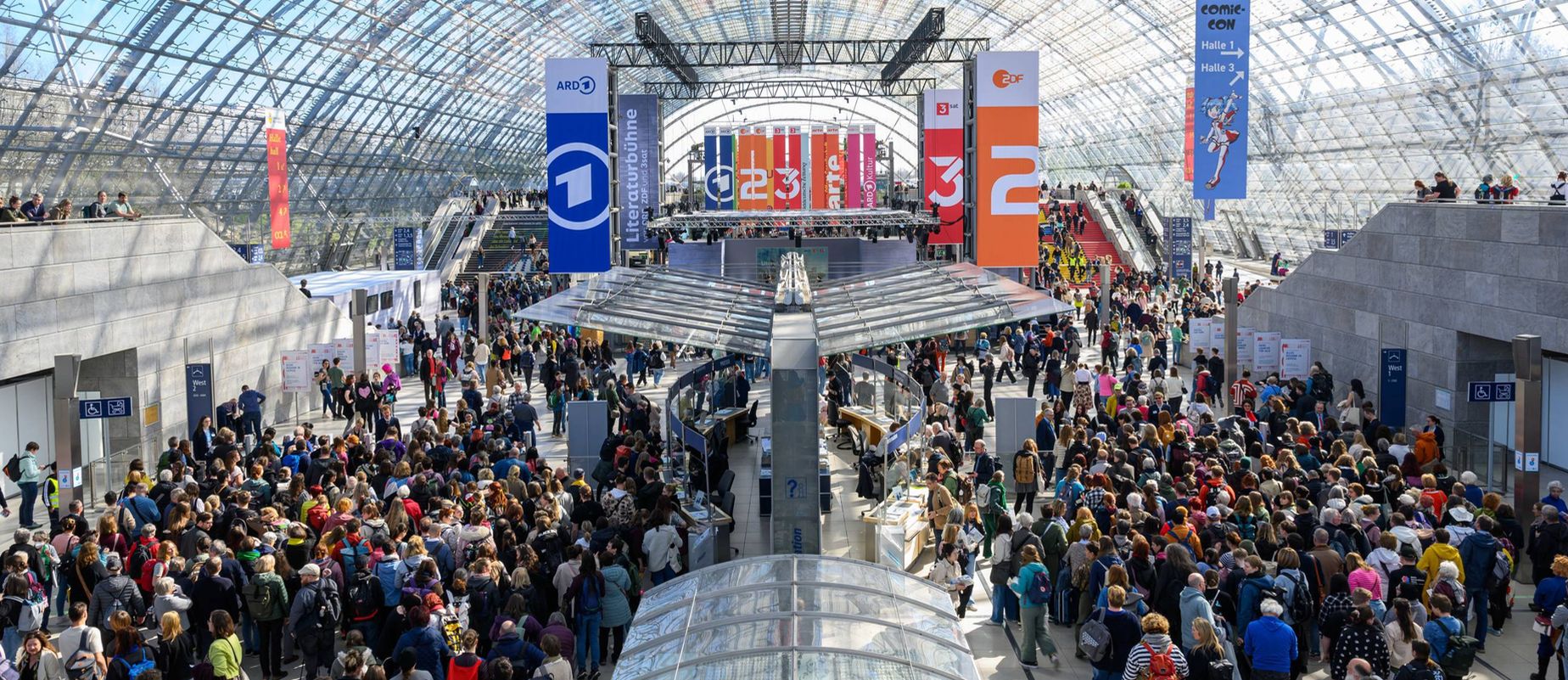
This year's Leipzig Book Fair (March 19-22, 2026) turned into such a garden for four days. It attracted a record-breaking 313,000 visitors and hosted 2,044 exhibitors from 54 countries. The motto of this year's fair was: "Where Stories Connect Us."
The Leipzig Book Fair Prize is also a connector, not least because it is awarded in three distinct categories: Fiction, Non-Fiction/Essays, and Translation. In contrast to the German Book Prize, the jury consists exclusively of critics. Guided by a commitment to discovery, an intellectual stance, and the joy of reading, this year's jurors included Katrin Schumacher (MDR Kultur, 3sat), Zita Bereuter (ORF), Kais Harrabi (DLF Kultur), Katharina Herrmann (blog "Kulturgeschwätz"), Thomas Hummitzsch (freelance critic, intellectures.de), Judith von Sternburg (Frankfurter Rundschau), and Tilman Spreckelsen (Frankfurter Allgemeine Zeitung). We seven jurors were presented with 485 submissions this year.

The Presence of History
Books can transport us to other places and times—and in so doing, highlight resonances between the present and the past. A quick glance at the books we nominated, one might assume we were a jury that was particularly interested in history—yet the contrary is so. We were interested in the present that is being told alongside it. This present is reflected in the books widely discussed at the fair: for example, Die Wut ist ein heller Stern (Anger is a Bright Star, Hanser) by Anja Kampman. The setting is in Hamburg at the variety theater Alcazar, where the protagonist Hedda works as a performer in the 1930s. The narrative relates the shifts that slowly but surely turn the city from a red (Communist) Hamburg to brown (Nazi). With extraordinary linguistic precision and atmospheric depth, Anja Kampmann describes the precarious existence of a variety show dancer in the early years of Nazi Germany, and the dwindling safe havens for all those who were not supposed to have a place in that Germany.
Katerina Poladjan’s award-winning novel Goldstrand (S. Fischer) similarly depicts a world in decline, while drawing clear parallels to the present. Eli, the protagonist of the novel, is a director known for his visually stunning films. He lives in a crumbling Roman villa, spectator to a growing loneliness that takes hold around him. His presence in the narrative gives the book a fantastical structure, culminating in a mythical journey to the Black Sea. A novel that masterfully guides the reader through European history and its vicissitudes. “Where do I belong?” Eli asks—a question that is posed again, in a different and more urgent context, in the two nominated non-fiction books by Marie-Janine Calic, „Balkan-Odyssee. 1933-1941. Auf der Flucht vor Hitler durch Südosteuropa“ (C.H. Beck) (Balkan Odyssey. 1933–1941: Fleeing Hitler Through Southeastern Europe”), and Jan Jekal’s „Paranoia in Hollywood. Wie die USA exilierte Künstler erst retteten und dann verfolgten. 1941–1953 (Matthes & Seitz Berlin) (Paranoia in Hollywood: How the U.S. First Saved and Then Persecuted Exiled Artists. 1941–1953). Both books shed light on the flight to the East and West almost as though they were mirror-images. Some people went to Hollywood; others ended up in Southeast Europe. The Balkans, in particular, have been largely overlooked in exile studies until now—Marie-Janine Calic fills a gap with this impressive work. Jan Jekal’s book, which leads in the opposite direction, has the makings of a true blockbuster. Starring luminaries such as Thomas Mann, Marlene Dietrich, and Bertolt Brecht; it features a plot full of tragic twists and grand emotions. Along the way, Jan Jekal also uncovers striking parallels to the present: refugees were rarely welcomed with open arms—not even stars.

The Shift to the Right and Nationalism
“Where Stories Connect Us.” Interestingly, the organizers of Leipzig 2026, did not opt for a host country as is usually the case, but decided on a focus theme which would link several countries from Germany to Ukraine: the Danube. It was indeed a timely idea to focus not on a single nation, but rather highlight the deep connections between European countries. Aptly, the speech by this year’s recipient of the Leipzig Book Award for European Understanding focused on hospitality and translation. Miljenko Jergović was honored for his collection of stories „Das verrückte Herz. Sarajevo Marlboro Remastered“ (Suhrkamp), (The Crazy Heart. Sarajevo Marlboro Remastered) (Translated from Croatian by Brigitte Döbert). The siege of Sarajevo, where the author was born in 1966, is at the center of this collection of stories which demands a form of aesthetic resistance against oversimplifications and the dangers of nationalism. One of the most impressive books of the spring, which aligns with the belief in resistance, was penned by Michal Hvorecký, who until recently had worked at the Goethe-Institut in Bratislava. It is titled “Dissident” (Klett-Cotta), a kind of personal narrative about his home country of Slovakia—which has turned into a sort of Hungary 2.0. Hvorecký details how he came under scrutiny by the Minister of Culture; how he traveled across the country to demonstrations, held speeches, and forged connections. Although “Dissident” appears in the singular in the title, Hvorecký argues that joining forces is a powerful way to grow strong together and create a counter-power against those in power.
Constantly, we are being challenged to find a reliable source of information about every day events, and it is growing more difficult by the day. Reality is elastic, depending on the feed; our attention is fed with uncertainty through incessant updates, and this feeding is, of course, an active process with each glance at the timeline. Perhaps, the silver lining lies in the fact that we can at least control this process, for we can opt for literature, the antagonist of the affect-driven feed. Many books this spring offer valuable insights into the various contexts of our present day lives, and why it is crucial that we join forces. The celebrated author Ronen Steinke writes about the status quo in Meinungsfreiheit. Wie Polizei und Justiz unser Grundrecht einschränken – und wie wir es verteidigen. (Piper) (Freedom of Speech: How the Police and the Judiciary Restrict Our Fundamental Right—and How We Defend It). This is a book that becomes particularly interesting in light of the right-wing shift across European.
Sally Lisa Starken also aims to broaden our perspective in Wenn der rechte Rand regiert (Penguin) (When the Right-Wing Fringe Governs). The author traveled to countries where democracies had eroded and warns that this is also happening in Germany. While the AfD leads in the polls and democracy threatens to slip away, we are confronted with a decisive question: Can we still find a way to counteract this trend? This book provides answers and draws lessons from developments in other countries. Words of warning can also be found in Angelique Geray’s Undercover unter Nazis: Als Frau im Herz der rechtsextremen Szene (Hoffmann und Campe) (Undercover Among Nazis: As a Woman in the Heart of the Far-Right Scene). Meanwhile, Matthias Quent’s Keine Macht der Ohnmacht (Piper) (No Power to Powerlessness) and Christoph Bartmann’s Attacke von rechts. Der neue Kampf um die Kultur (Hanser) (Attack from the Right: The New Battle for Culture), offer words of encouragement by highlighting the strategies individuals can adopt in their political actions.

In-Depth Historical Research
Books can do so much: they can help us escape and pose questions; they can be works of art, function as a rearview mirror and a crystal ball rolled into one, perhaps even a fire extinguisher that arrives in the knick of time. A striking number of titles this spring delve into deep historical research. Judith Hermann’s eagerly awaited new book, Ich möchte zurückgehen in der Zeit (S. Fischer) (I Want to Go Back in Time), is such a work. Breaking with all conventions of a historical non-fiction narrative, she explores the gaps in her own family history. Hermann courageously writes about the "not knowing" that catches up with us all— the fog that replaces certainties in the face of dying eyewitnesses and passage of time. A book that is, in the truest sense, uncannily harmonious in its circling of the void left behind; a literary conjuring of spirits that in this density, could only have been written by Judith Hermann. Memory and the culture of remembrance are also at the heart of Ines Geipel’s Landschaft ohne Zeugen: Buchenwald und der Riss der Erinnerung (S. Fischer), (Landscape without Witnesses: Buchenwald and the Fracture of Memory). In it she takes a very personal look at the history of the Buchenwald concentration camp, and of a period that has received little attention to date: the days following liberation in the spring of 1945. Geipel examines what actually happened during this historic transitional moment and which narratives have subsequently been layered over in hindsight. Far more controversial, yet certainly a widely read non-fiction book this spring is Jana Hensel’s Es war einmal ein Land (Aufbau) (Once Upon a Time There Was a Country), she looks at history to explain why the East is turning away from democracy. The two large-format books among the 2026 non-fiction nominees travel even further back in time: Die Frau als Mensch 2: Schamaninnen (Reprodukt) (Woman as Human 2: Shamanesses) by Ulli Lust and Manfred Pfister’s Englische Renaissance (Galiani Berlin) (English Renaissance). Both books are meticulously researched and shaped by their respective themes (feminism and the Renaissance), and offer insights into worlds of the distant past. Both are wonderful time capsules.

The East and Beyond
If you are looking for great novels, captivating stories, and literary panoramas, take a look at some of the novels about time travel. A new voice in this genre is Helene Bukowski, whose third novel, Wer möchte nicht im Leben bleiben (Ullstein) (Who Wouldn't Want to Stay in Life), delves deep into the history of the GDR, while creating a portrait of the artist, Christina, who has lived a short and intense life. As a highly gifted young woman, she was trained and drilled at music conservatories in Berlin and Moscow; shortly after she returned to Germany in 1985, she committed suicide. Rich in allusions and hauntingly evocative, Helene Bukowski traces the life of a pianist, who speaks to us from the surprising perspective of a ghost. Lukas Rietzschel’s new novel Sanditz (dtv) begins in an equally imaginative manner, weaving together the stories of a family and the residents of Sanditz from multiple perspectives into a panorama of German history—from the end of the GDR to the present day. The crime novel Keine besonderen Auffälligkeiten (Edition Nautilus) (Nothing Unusual to Report) by Sophie Sumburane also takes us back to the early days of reunification, an era that also serves as the historical backdrop to her detective novel. Based on a true case, she tracks down the GDR’s last serial killer, proving in the process that every good crime novel also is a good social novel.
Norbert Gstrein's Im ersten Licht (At First Light) (Hanser), and Dimitré Dinev's Zeit der Mutigen (Kein & Aber) (The Time of Heroes) represent major novels whose scope extends beyond the East. Both novels are about wars, and both feature protagonists who do not go off to fight, yet are inextricably defined by it. Elli Unruh is a major discovery with Fische im Trüben (TRANSIT) (Fishing in Troubled Waters). She tells the story of the unique Mennonite culture in Kazakhstan with intelligence and poignancy, while avoiding the trap of romanticizing her subject. Her novel opens up a world that is both foreign and now vanished. Matthias Nawrat creates a different panorama in Das glückliche Schicksal (Rowohlt) (The Happy Destiny), in which he sends the young Polish psychologist Wanda Karłowska to Venice in 1983, where she interviews the exiled Henryk Mrugalski about his research. Or is it perhaps an interrogation after all? Suspense and family secrets—anybody who enters the world of Alena Schröder’s characters will once again be captivated by the third part of her trilogy: Mein ganzes Leben, Öl auf Leinwand, ohne Titel (dtv) (My Whole Life, Oil on Canvas, Untitled) which became an instant bestseller this spring. The same goes for the booksellers' "insider tip": Hannah Häffner’s “Die Riesinnen” (dtv) (The Giantesses). This sprawling novel is the surprise hit of the season, a story of three generations of women who are simply too large for a “normal” life.

Women Who Fight Back
This year’s book fair also was dominated by debates around digital violence, misogyny, and rape through internet pornography. Also sparked by athe scandal around actress Collien Fernandes, who courageously brought these issues into the media spotlight. Numerous books on the subject were also featured at the fair, such as Nicole List’s Angst vor Männern (Wasser Publishing) (Fear of Men) which emphatically demands that all of us can live a life free of fear, and describes what society needs to address in order to achieve it. Andrea Böhm’s dazzling historical account of female boxers, wrestlers, and fighters throughout the centuries in Fighting Like a Woman: Die Geschichte der Frauen, die zurückschlagenn (Rowohlt) (Fighting Like a Woman: The History of Women Who Strike Back) is a fascinating read. Finally, Ole Liebl’s reflects on a new form of masculinity in Brutal fragile Typen. Männer und Gefühle (Harper Collins) (Brutally Fragile Guys: Men and Emotions).
Looking back on this year's multifaceted contemporary literature has inspired me to think about our collective tendency to react impulsively to current events. Yet, when we immerse ourselves in a book, we are exposed to a fundamentally different form of narrative—a narrative that carries with it the time of its creation, the long weeks of experience, thought, writing, rewriting, doubt, and lived life, the lifetime embedded in every book and the aura that surrounds each one. Literature takes its time; that is why it is so valuable. It is a gift of time from every writer to us readers. May you find great joy in receiving these gifts this spring.
Dr. Katrin Schumacher is a literary scholar, author and radio critic for public broadcasting. She was the Chair of the Jury for the Leipzig Book Fair Prize 2026.
Translated by Zaia Alexander