Book World
Progressing from living in mere proximity to living cooperatively
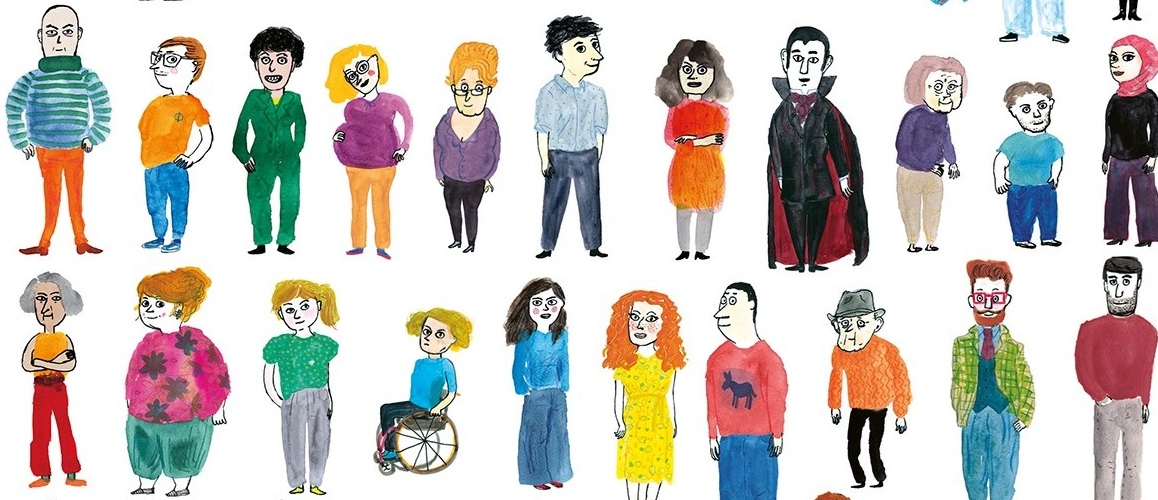
How do we want to live our lives within the hurly-burly of society? Within our family, within the context of school, in the public domain? This is a question that confronts us throughout our life for a whole multiplicity of reasons. These aspects of life are dealt with in current children’s literature in numerous creative ways, whether it be in illustrated story books, in illustrated factual books aimed at early-years primary-school children, or in raw stories recounted by homeless youngsters.
by Antje Ehmann
Picture books
With his characters Bear and Weasel, Jörg Mühle has created a pair of strongly individualised protagonists who take us through several different modes of communal life. The tale ‘Zwei für dich, einer für mich’ (‘Two for you, one for me’) deals with the challenge of how to fairly share out three mushrooms; while ‘Morgen bestimme ich’ (‘Tomorrow I will do the choosing’) examines the rules that operate when two people find themselves sharing a period of time together; and ‘Das war doch keine Absicht’ (‘I really didn’t mean to’) explores the noble art of saying sorry. As the Frankfurt-born illustrator Jörg Mühle himself puts it: ‘The two of them don’t often get into a row, but, when they do, things sometimes turn quite nasty, but rarely become subjective, personal or, worst of all, hurtful. Fortunately neither the bear nor the weasel is inclined to bear a grudge, and once they’re through arguing they’re soon back on good terms.’ To children who respond to the stories’ exciting trajectories, intense feelings and unexpected plot-twists, they offer a helpful opportunity for them to ask themselves such questions as ‘So how could I best go about saying sorry?’
Regina Schwarz and Yayo Kawamura also deal with interpersonal relationships and intercommunication questions in their children’s book Hör mir mal zu! Über Sprache und Miteinander (‘Just listen to what I’m saying! On language and social interaction’). But intercommunication between different cultures is also something that has to be learnt. In the words of Yayo Kawamura, who as illustrator of this factual picture book successfully brings together a multiplicity of contrasting perspectives: ‘I noticed early on how differently communication can often function in Japan and Germany. In Japan someone might say for instance that they can play the piano just a little, and then sit down and perform like a professional. Modesty is highly valued in Japan, whereas in Germany the trait of self-effacement can come across as distinctly irritating. This has taught me that there is no right or wrong way in such matters, and that we need to be sensitive to the ways in which people interact in particular situations.’ There is scope otherwise for incessant misunderstandings about the most everyday things - whether to send a postcard or an email, for instance, or how to deal with other people’s animals or private languages, or what body language to adopt. These issues are all brought together in short texts enlivened with plentiful humour and helpful tips.

Non-fiction
In her book Klassenbuch. Wer gewinnt das Spiel des Lebens? (‘Registering class. Who wins out in the game of life?’), Gerda Raidt looks at an entire class of primary school children and investigates in detail how disparities between the children come into being. As Raidt herself has explained, ‘The question has exercised me ever since the first books on the topic by Didier Eribon and Annie Ernaux arrived in this country from France. It is very illuminating to reflect on class divisions when looking at the world in this perspective. Even as a child I was struck by these divisions, but whenever I raised the matter with adults they blithely sidestepped the issue. Then I asked myself: “What if we had known about these things earlier? What if we had realised even as children that such questions need to be understood at the structural level, not in terms of individuals?” ’ Raidt successfully manages to convey a detailed sense of her approach through both her words and her illustrations, thereby helping to empower her child readers.

Such empowerment conducing to inner stability and strength has often not been accessible to the young. In his book Wie Treibholz auf Asphalt. Junge Menschen erzählen von ihrem Leben auf der Straße (‘Like flotsam in the gutter. Young people speak about their lives on the street’), Kobai Halstenberg takes a close look at the challenging conditions in which these outcasts find themselves living. As he himself explains: ‘I’m interested in the concerns of these youngsters. They’re a minority in our society, politically disregarded and socially neglected. I asked myself why in one of the world’s richest countries young people find themselves having to live on the streets. So I went out and asked them.’ 15-year-old Lukas is the youngest of his interviewees, while Terri, Socki and Alex are the three oldest at 26. Their intense and patently honest accounts are recorded here, and are often quite painful to read. This is a book that lends itself to being read and discussed in upper-year school classrooms, for it makes clear how we really ought to deal with one another in a way that is humane and respectful and fully recognises others’ dignity.
Antje Ehmann works as a freelance journalist, consultant and member of award panels within the area of children’s and young adult literature.
Translated by John Reddick
Copyright: © 2026 Litrix.de