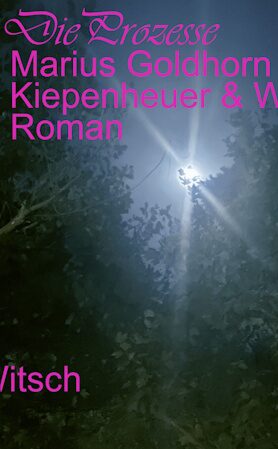
Marius Goldhorn
Die Prozesse
[The Trials]
- Kiepenheuer & Witsch Verlag
- Köln 2025
- ISBN 978-3-462-00780-0
- 288 Pages
- Publisher’s contact details
For this title we provide support for translation into the Polish language (2025 - 2027).
Sample translations
Post-apocalypse and pop-melancholy: Marius Goldhorn’s literary mapping of a world in crisis
In “The Trials”, Goldhorn combines a pop-melancholic love story with AI speculations, the climate apocalypse and social utopia: “We couldn’t sleep. Ezra and I left our hotel room at dawn, and didn’t run into anyone.” Cosy and eerie in equal measure, the post-apocalyptic novel opens in late summer of the year 2030, introducing the first-person narrator, a nameless twenty-nine-year-old, and his partner, who is older than him “by more than seven years”. They live in Molenbeek, the Brussels neighbourhood which became known in the 2010s as the residence of Islamic terrorists, in a one-bedroom apartment with the high-rise number N8. When contracted in the original German, N8 can also be sounded out poetically as “N-Acht”, meaning “night”. “At night I sat in N8, my feet on the windowsill, and listened to occupier radio on my headphones. I got up, went to bed and watched Ezra sleep.”
Further south, in the increasingly drought-ridden countries, tropical dengue fever has broken out. In the metropolises, the barricades burn. The elite, like in Boccaccio’s plague narrative “The Decameron”, have fled to remote weekend homes or into gated communities. To escape this ravaged reality, the queer couple migrate into the digital world: they spend their days gazing into laptop and smartphone displays, reflected in the screens like Narcissus is mirrored on the surface of the water in Ovid’s “Metamorphosis”, forgetting the world around them.
The narrator of this will-o’-the-wisp novel works as an AI-designer, while his older boyfriend Ezra runs a Zeitgeist blog, tellingly naming himself Deborn. After a stay in a psychiatric institute, Ezra chose the “Angelus Novus” as his profile picture, Paul Klee’s watercolour and oil depiction about which Walter Benjamin once wrote: “It shows an angel which seems to be distancing itself from the object of its attention. (…) Its face is turned toward the past. Where we see a chain of events, it sees a single catastrophe which relentlessly heaps ever-accumulating ruins before its feet.”
Following Walter Benjamin’s dystopian interpretation of history, Ezra blogs about trees in bombed swathes of land, about the Book of Isaiah, “about the OPV/HIV theory, about the dominance of genes, about cloning”, about depression, the war “and great war poetry”. For him, these are all signs of extinction, of a human exodus.
In the span of just one year, Marius Goldhorn’s “The Trials” narrates the queer couple’s journey from Brussels via Ostend to Liguria, in search of a healing place for Ezra. He becomes gravely ill, a travel companion who is wasting away, suffering from the genetically determined, irreparable skin dysfunction epidermolysis bullosa, also known as “butterfly skin”. The narrator becomes his lover’s palliative carer on this flight to Liguria, where the couple are eventually taken in by an acquaintance who lives in a refuge – this too a topos of many post-apocalyptic narratives; the improbable safe space which is initially shielded from the catastrophe. “It’s a sanctuary, I thought, a hiding place. A large cactus grew up one of the house walls to the roof.”
Marius Goldhorn is one of those young German-speaking writers who are reflecting on new forms of communal life, on future refuges, on the position of human beings in relation to artificial intelligence and those “war machines” which Gilles Deleuze and Félix Guattari were already considering back in 1980 in their epoch-making “A Thousand Plateaus”. Embedded in the ancient form of the hero’s journey, this impressive novel speculates on our not-so-distant future. Marius Goldhorn combines poetic style with prosaic futurology, himself viewing with widened eyes the monstrosity of human history as “a single catastrophe which relentlessly heaps ever-accumulating ruins before [his] feet.”
Translated by Jamie Lee Searle

By Jan Drees
Jan Drees is the literature editor for Deutschlandfunk and host of the radio show “Büchermarkt.” He is on the team of critics for the 3sat broadcast “Kulturzeit,” a member of various juries, and the author of novels and works of nonfiction like “Staring at the Sun” (2000), “Letzte Tage, jetzt” (2011), “Sandbergs Liebe” (2019), and “Literatur der Krise: Das Novellen-Werk von Hartmut Lange” (2022). Jan Drees runs the blog lesenmitlinks.de.
Publisher's Summary
In hypnotic prose, Marius Goldhorn leads two reeling men through a shattered continent, torn between its past, its crimes, and the longing for a new beginning.The Trialsis a stirring story about love, guilt, and innocence – and a novel of enigmatic clarity.
Brussels, late summer 2030. The city is in upheaval. People are gathering everywhere – across the city’s outskirts, in its market squares and museums, and along its boulevards – protesting and celebrating. Unexpected communities are emerging, old orders are crumbling.
The narrator and his partner, Ezra, are vacationing in Ostend. When they return to Brussels, they’re swept up in events that soon put their relationship to the test.
When Ezra, who runs a political blog, becomes the victim of an attack, the couple leaves Brussels and heads to northern Italy, seeking refuge on the remote farm of a mysterious gardener. But their retreat turns into a surreal journey through hell – a fateful journey through the world of the dead and the realm of ghosts.
(Text: Kiepenheuer & Witsch Verlag)