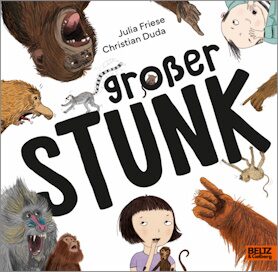
Christian DudaJulia Friese
Großer Stunk
[The Big Stink]
- Beltz & Gelberg Verlag
- Weinheim / Basel 2025
- ISBN 978-3-407-75998-6
- 56 Pages
- Publisher’s contact details
For this title we provide support for translation into the Polish language (2025 - 2027).
Sample translations
Baffling Monkey Business
While Leander is delighted by the large turnout of lots of different primates the monkeys are furious: orangutans, stump-tailed monkeys, squirrel monkeys, chimpanzees, gorillas, baboons, bonobos, marmosets, pygmy marmosets, uakaris, tamarins, gibbons, spider monkeys, mandrills, Spix's macaws, Barbary macaques, even lemurs, which everybody knows are not in the least monkeys. All of them are convinced they are the only monkeys in the room, and they refuse to believe there could possibly be any monkeys other than themselves. And thus begins a heated discussion about what constitutes a real monkey. While they might generally agree that a head, arms, legs, fingers, toes, eyes, ears, nose, mouth, and lots of hair are typical features, the question of whether monkeys must have a tail causes an uproar. They examine the various body shapes and sizes, along with the colors of their coats. Leander tries to calm the colorful group, hurling insults back and forth at each other: “It doesn’t matter whether you look alike [...]. Inside, you're all the same.”
And that's when the monkey business really gets going. What follows is "a silent commotion. A silent commotion is actually loud too, you just can't hear it.” That's when Luzi bursts onto the scene. The girl also had read Leander's notice and decided to model for the artist. But he can't figure out why. “Humans are monkeys!” Luzi explains to him and the others. And she continues: “Monkeys are animals.” The monkeys—including Leander—are deeply disturbed. That cannot and dare not be true.
Leander, who sees himself as an artist, is unnerved at the idea that he, too, might be a monkey and an animal. But this is precisely the twist in the narrative. When he – completely beside himself – takes off his clothes, everyone can see: Leander also has a head, arms, legs, fingers, toes, eyes, ears, nose, mouth, and quite a lot of hair (especially on his back). What a revelation! And what a spectacle!: "Then everyone was seized by an irrepressible urge. They picked up paper and brushes, chose their colors, and hurled them at each other. Those who were able to do so, climbed the walls. Those who could not, caused a huge racket, rolled their eyes dramatically, and beat their fists against their chests until the air shook and the window panes rattled. Luzi belted out a song. Leander yelled “Oh la la!” That's French and means “How wonderful!
Christian Duda und Julia Friese narrate their story with thrillingly restrained, almost sober-sounding texts and expressive images that offer a glimpse into the artist's sparsely furnished studio and colorful commotion. In her vivid drawings, Friese plays with perspectives, proximity, and distance, using the white space on the pages as a stage for the monkey business that reveals the absurdity of prejudice and exclusion without pointing fingers. For example, she juxtaposes realistically painted monkeys (which are introduced individually in the afterword) with stylized drawings of humans. With a knowing wink, she questions our concepts of identity as well as the relationship between humans and animals, opening up space for philosophical questions. “Big Stink” is great picture book art in a small format that shows how multi-layered, funny, and enlightening storytelling in text and images can be for young and old alike.
Translated by Zaia Alexander

By Marlene Zöhrer
Marlene Zöhrer is a professor, juror, public speaker, and writes reviews on children's and young adult literature. She teaches children's and young adult literature and German didactics at the University of Education Styria in Graz.
Publisher's Summary
Leander wants to paint monkeys and invites them over to his place. Everyone is welcome. But the monkeys get into an argument. Each one claims to be the only real monkey! But when a child suddenly appears at the door and claims that she, too, is a monkey, the emotions run wild. Until they all understand that in spite of external differences, they are very similar. The story sensitizes the reader in an honest way to the subject of discrimination and exclusion. A powerful book on the omnipresent topic of prejudice. Draws attention to discrimination and raises awareness. Child's perspective makes the topic tangible.
(Text: Beltz & Gelberg Verlag)