Annekathrin Kohout
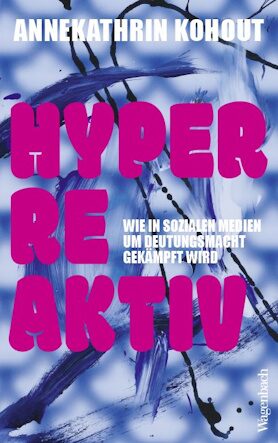
Hyperreaktiv. Wie in Sozialen Medien um Deutungsmacht gekämpft wird
[Hyperreactive. How social media is vying for the power of interpretation]
- Wagenbach
- Berlin 2025
- ISBN 978-3-8031-3762-3
- 192 Pages
- Publisher’s contact details
For this title we provide support for translation into the Polish language (2025 - 2027).
Sample translations
We Hostages of Feedback Culture
Just a few years ago, today's ADHD diagnosis was known as "burnout," and in the 19th century it was termed neurasthenia. But the underlying concept remains the same: an inability to process a variety of stimuli simultaneously; distinguish between what is important and unimportant; interesting and uninteresting, loud and soft. This sensory overload gives rise to a sense of being powerless.
As hostages of today's feedback culture, which follows our every digital step, we've been familiar with this feeling for quite some time now. The Internet of platforms is a relentless invitation to react to what is being presented, with the singular goal of focusing the user's attention on the platform or the product.
If the television age cautioned that viewers were doomed to becoming passive observers, who consumed world events from their armchairs; today we are experiencing a radical change. The voyeur of yesteryear has now turned into the constructor of their own media reality. Users are constantly expected to give feedback, intervene, comment on social media and on other people's comments. The social web operators call user's hyperreactive behaviour "engagement." This euphemism conceals the fact that such behavior often is not in the spirit of civic engagement, but rather about entangling users for as long as possible in a self-referential simulation of a conversation. In the author's words: "This technical logic has far-reaching consequences: it rewards not quality or truth, but responses. Content that triggers strong emotions—outrage, fear, enthusiasm—is systematically favored, while nuanced, balanced content vanishes into oblivion."
None of this is particularly new. Yet, as a knowledgeable stakeholder in new net cultures, Annekathrin Kohout allows us a look behind the scenes of the platforms. How exactly do the social web's comment features function? How do the various layers of meaning (superimposed comment bubbles, emojis, stickers, photos and video) often render the original message irrelevant. "On Instagram," writes Kohout, "the story function has evolved from an ephemeral format for snapshots into a veritable reaction arena." Kohout never forgets to reflect on her own behavior as a media user as she takes on the role of ethnographer of a giant digital land we all are part of; whether we want to be or not. Feedback here is the new currency in the battle for our attention, for our – one might say – attention span.
Extensive research has proven that the new reaction culture not only has had a massive impact on identity formation of the individual, but especially on children and young adults. Public discourse has suffered lasting effects by the imperative for constant reactivity. Disinformation is now a feature of how public opinion is manipulated, as well as the deliberate use of misunderstanding. It serves to entangle the potential opponent in an endless loop of self-justifications, with the ultimate purpose of letting the poison of slander take effect.
As this book vividly shows: We are observers as well as perpetrators of an epistemic break that sabotages our own image of a critical public sphere. The way truth is manufactured today differs categorically from all conceptual reasoning that we can appeal to, and which is provided by a democratic society. The public sphere today can no longer be separated from the constant pings of our devices: neither from our hyperreactive knee-jerk actions, nor from our feelings of powerlessness, given the sheer abundance of narratives, counter-narratives, slanders and conspiracies.
Almost everything on the web challenges us to be interpreters and competes for the status of meaning. "I noticed," the author writes in view of the Russian invasion of Ukraine, "how the gap had grown between being informed and the capacity to act." And she adds: "The hyperreactive person doesn't consume news primarily to be informed, rather they do so in order to react." If one compares the first tentative postings from ten years ago with the differentiated internal communication of today's commenting functions, this book inspires us to think about the social media phenomenon within the context of its eccentric history.
Translated by Zaia Alexander

By Katharina Teutsch
Katharina Teutsch is a journalist and critic. She writes for newspapers and magazines such as: the Frankfurter Allgemeine Zeitung, Tagesspiegel, die Zeit, PhilosophieMagazin and for Deutschlandradio Kultur.
Publisher's Summary
Have you seen Greta’s post? What sort of image has she shared? Is it genuine? The cultural specialist Annekathrin Kohout casts light on the excitational dynamics inherent in social media - looking at the structures within a network of reactions that has long since been determining the tenor of public debate well beyond the ambit of the internet.
Why are online communications characterised by irritation, misunderstandings and mistrust? How are political axes ground on the internet through images and their interpretation? The cultural specialist Annekathrin Kohout investigates social media as a world in which everything is geared to provoking the strongest possible reactions. Those who constantly pass judgements, make comments, create content, or whose contributions themselves spark strong reactions, are the only people who get rewarded by the algorithms – with disastrous consequences, not least for discussions taking place other than on internet platforms. Drawing on her own personal experience, on her exploration of particularly striking cases, and on theoretical considerations, Kohout graphically exposes the ways in which social media imitate analytical, forensic and investigative methods in order to spread targeted disinformation, and material aimed at causing the polarisation of opinion. And she also shows how every single internet user bears some responsibility for this. Anyone who is still disinclined to abandon the idea of a credible democratic discourse should hasten to read this account of the current digital world.
(Text: Wagenbach)