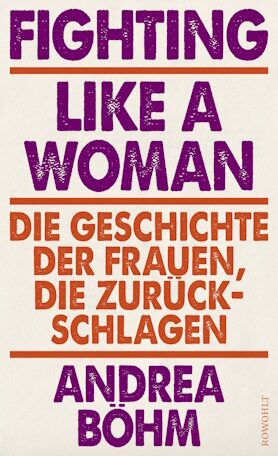
Andrea Böhm
Fighting Like a Woman. Die Geschichte der Frauen, die zurückschlagen
[Fighting Like a Woman]
- Rowohlt Verlag
- Hamburg 2026
- ISBN 978-3-498-00397-5
- 272 Pages
- Publisher’s contact details
For this title we provide support for translation into the Polish language (2025 - 2027).
Sample translations
Women Who Whack
The notion that women are physically inferior to men appears to be a reality that must be faced. Philosophers and scientists throughout the ages believed in the natural inferiority of the entire female nature. It is worth noting that the generic masculine used here is not generic, but strictly masculine. It was men who explained women, not women who explained themselves.
Thomas Aquinas, for example, came up with a rather catchy phrase, describing women as "an error of nature.” According to him, their alleged “excess of moisture and low body temperature” made them physically and mentally “inferior.” The Dominican friar relied on Aristotle, who believed that men were endowed with reason, whereas women were “defective and misbegotten.” Another man—the philosopher Arthur Schopenhauer—put it no less crudely: “The mere sight of the female form is proof enough that woman is destined neither for great mental nor for physical labor.” It is hardly surprising that even Darwin, who challenged the Christian creation story with his progressive theory of evolution, beat the same drum, averring that man could attain "a higher eminence, in whatever he takes up, than can woman.”
Reading such views today, we can see how far feminism has come since the suffragette movement of the 19th century. Female resistance has frequently been historicized as a gentle protest. That said, feminist scholars everywhere have met with women who argue, demonstrate, and hurl their bras, or who simply are shrewd at networking. But longtime foreign correspondent Andrea Böhm wondered where were the women who responded to physical violence with physical violence. Women who had refused to accept their “powerlessness” as a given? And what historiography had done with those women who were tired of talking and preferred to speak with their fists?
Andrea Böhm, who currently is a staff writer on politics for the weekly newspaper Die Zeit, has practiced martial arts for years. Throughout her extensive travels and various interim residences, she has always been drawn to martial arts schools. This interest has led to a book that traces the history of women’s physical struggle against patriarchy throughout the world. It begins with the American suffragists Susan B. Anthony and Elizabeth Cady Stanton, who fought for women’s suffrage—a right that had repeatedly been denied them. Every young girl, Stanton had said in an interview, should learn to shoot so she can handle men—and also “have a great big Newfoundland dog by her side.”
Andrea Böhm finds this more revolutionary than the two women’s rights activists’ threat to proclaim a women’s republic. For the first time in the history of women’s rights movements, the male monopoly on violence was directly being challenged. And this would grow into an ongoing physical exercise for courageous women over the course of the twentieth century. Consider, for instance, the English suffragette Edith Garrud, who taught jiu-jitsu to women who wanted to defend themselves, and in the process assembled a dedicated security force for the scandalous public appearances of her fellow activists.
"Broadly speaking, the multi-disciplinary women’s sports movement sought to liberate the female body from the constraints of the Victorian corset. Of course, it was male doctors, who protested vehemently, fearing that a woman’s “graceful” gait would be compromised by “waddling,” while playing hockey, and that their “lush hair” would be ruined by swimming. But once women had a taste of freedom, they were eager to continue flexing their muscles.
Böhm traces her “History of Women Who Fight Back” right up to the present day. Yet she glorifies nothing and nobody in the process. She notes, for instance, that women’s boxing flourished among the white middle class during the early twentieth century, fueled in part by the racist trope of the black male aggressor.
Böhm's book encompasses more than just historical accounts. She visited female wrestlers in Mexico who practice Lucha Libre – a theatrical form of wrestling – to fight femicide in their country. Böhm has also spoken with Kurdish women fighters. She visited the descendants of the famous women’s army in the Kingdom of Dahomey, in present-day Benin, American MMA heroines, and trans women in the Thai sport Thai Muay. She takes us on a riveting journey around the world and through cultural history. What she discovers on this journey is socially unacceptable and yet ubiquitous—in other words, scandalous: women who dish it out.
Translated by Zaia Alexander

By Katharina Teutsch
Katharina Teutsch is a journalist and critic. She writes for newspapers and magazines such as: the Frankfurter Allgemeine Zeitung, Tagesspiegel, die Zeit, PhilosophieMagazin and for Deutschlandradio Kultur.
Publisher's Summary
The Women Who Strike Back
Female strength is not an exceptional state, but a historically documented part of social reality.
In a time of global anti-feminist backlash, journalist Andrea Böhm uncovers the forgotten stories of women who physically resist their oppression – fighting with every weapon at their disposal. From 18th-century female boxers and Jiu-Jitsu suffragettes to Berlin schoolgirls learning self-defense, women have long questioned the belief in their physical inferiority to men.
Andrea Böhm asks: Is the female body truly as vulnerable, available, and exposed as we have been taught from childhood? Is the male monopoly on violence a myth? On her travels, she encounters Mexican wrestlers defying the female victim role, Kurdish female fighters dreaming of a feminist utopia, Kenyan and German girls asserting themselves in violent environments, and the men who support them. They all reveal the active female body as the core of emancipation and self-assertion. An essential and personal plea for a physical feminism.
(Text: Rowohlt Verlag)