Finn-Ole HeinrichDita ZipfelNele Brönner
Aali muss los
[Eely has to go]
- Huckepack / mairisch
- Hamburg 2025
- ISBN 978-3-948722-48-7
- 64 Pages
- Publisher’s contact details
For this title we provide support for translation into the Polish language (2025 - 2027).
Sample translations
Learning to love eels
However, Aali’s story does not begin in the depths of the sea east of Florida, but in the Kiel Canal ‘one drizzly morning in the early autumn’. This particular morning is different from all the other mornings that Aali has ever previously experienced: he suddenly felt ‘a heaving sensation in his chest, a sort of trembling that went coursing through his entire body. As if he didn’t have enough water around him, even though he was busily swimming in the middle of the canal.’ This sudden change is very apparent to Aali’s friend Frank, the bream who for many years had been his trusty companion on his travels along the canal. ‘At this particular moment neither Frank nor Eely realised the truth, namely that Eely was in the grip of a radical metamorphosis from ‘glass eel’ to ‘silver eel’. “Metamorphosis” – really? So is it like in some ancient fairy-tale where a magician waves his wand and, hey presto, Cinderella turns into a princess? Well, not quite. But it’s a real metamorphosis all the same, and all the more impressive for that.’
Zipfel and Heinrich bring the story of the eel’s metamorphosis from ‘glass eel’ to ‘silver eel’, and of his eventful journey from the Kiel Canal to the Sargasso Sea, vividly and very amusingly to life. One striking element here is that the narratorial process itself is thematised: ‘Okay then: while Frankie swims off in slow pursuit of his old pal, I need to make it clear that I myself am not an eel, nor indeed any sort of fish. I’m guessing that that has probably already occurred to you – am I right? I’m actually a human being, a woman who tells stories. And as a story-teller I seek out the best, loveliest, biggest, funniest, saddest stories in the world in order to recount them to readers like you. And this is one such story’. Another striking element in the book is the repeated inclusion of visually differentiated panels containing factual information, bearing titles such as ‘The four lives of an eel’; ‘Aali’s magnetic odyssey’; ‘The Gulf Stream – an undersea autobahn’. Even this factual information is rendered exciting to read, and thoroughly entertaining, with the result that we follow Aali on his maritime journey with a sense of wonder and delight.
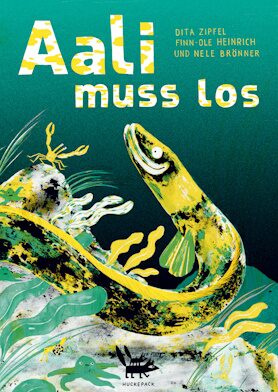
Nele Brönner’s illustrations contribute greatly to our reading pleasure. She envelops the book’s pages and the undersea world they depict in a fascinating blend of black ink complemented by green and turquoise shades, that perfectly captures the dynamic processes, currents and depths that characterise the ocean and its denizens. The atmosphere and multiplicity of the world depicted in her full-page illustrations result from Brönner’s sophisticated use of separately printed layers, each drawn in black with an admixture of either yellow or turquoise. The colour sequence of the background imagery that runs through the entire book effectively portrays the transformations of the eel and the regions through which he swims. Aali and the various creatures he encounters on his journey are drawn in black Indian ink, and the images are then digitally combined with the printed layers, a technique that by virtue of its subtle detailing serves to underscore the humour of the story.
When Aali finally arrives with a smile at his destination and plunges down into the dark depths of the Sargasso Sea, he leaves the reader in a quandary. For the story ends not with a miracle or with the pretence of an explanation, but with a mystery. For even today, science still has no answer to the question as to what actually happens down in the submarine jungle; how do eels spawn? What happens to the elderly eels that dive down into the depths and disappear? Zipfel, Heinrich and Brönner come up with a very appealing answer that may also count as a wise moral lesson, namely that not everything is capable of being understood; some mysteries are much better left unexplained.
Translated by John Reddick

By Marlene Zöhrer
Marlene Zöhrer is a professor, juror, public speaker, and writes reviews on children's and young adult literature. She teaches children's and young adult literature and German didactics at the University of Education Styria in Graz.
Publisher's Summary
Eely has spent almost his entire life in a very beautiful canal, happily doing his laps with his friend Frank. But suddenly Eelyrealises that he is changing, that he has to say goodbye and take the plunge into new waters: A long, exciting and adventurous journey begins.
It is a story about one of the oldest secrets of the sea: the mysterious migration of eels. But also about the courage to follow your heart, about an unusual friendship, and about why there are moments in life when you have to trust your inner voice.
Poetic and full of humour, Dita Zipfel and Finn-Ole Heinrich take us into the hidden worlds of the oceans. Their warm-hearted, clever storytelling makes the millions-of-years-old migration of eels tangible for young readers and shows how precious and worthy of protection these natural spaces are. Illustrator Nele Brönner transforms this extraordinary story into pictures that turn the book into a complete artistic work - and an invitation to see the wonders of nature with new eyes.
(Text: Huckepack / mairisch)