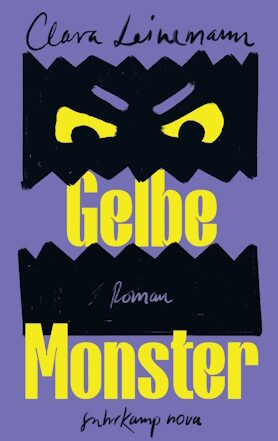
Clara Leinemann
Gelbe Monster
[Yellow Monsters]
- Suhrkamp Verlag
- Berlin 2026
- ISBN 978-3-518-43300-3
- 192 Pages
- Publisher’s contact details
For this title we provide support for translation into the Polish language (2025 - 2027).
Sample translations
The ultimate battle of the sexes
Charlie has behaved badly and wants to make amends. A doctoral candidate in mathematics, she’s a highly gifted, deeply troubled and hypersensitive individual who exhibits symptoms of borderline personality disorder. In other words, she’s a fascinating young woman but a mystery to herself: “Charlie had the deep-seated and fundamental conviction that everything about her was wrong. Ever since puberty she had wanted to change and be a better person. She wanted to be Shakira, she wanted to be Helene from class 9b, or the main character in a series that everyone in high school was watching: an unruly, beautiful teenage femme fatale with a glamorous drug problem.”
For a number of years Charlie has tried to fill her inner void with an uncontrollable rage, with self-harming behavior and behavior harmful to others. At the start of the novel, the bruised and battered Cologne high school student sits in a support group for violent women. Charlie, who herself looks like a victim of violence, is willing to sit down with a group of like-minded people and confront the monstrosity alluded to in the book’s title. “They would talk about forms of violence, about power and control, about signals, cycles of violence, conflict behavior, emotional regulation, female role models, self-understanding in relationships, parenthood, anxiety, humility, emancipation.”
In flashbacks and flash-forwards, Charlie reconstructs her amour fou with Valentin, a budding writer of about the same age who works as a bookstore assistant and at first seems like a better version of her own fragile self. He has green eyes just like her, and is talented like she is. Charlie sees herself in him but, like Narcissus, has merely fallen in love with her own mirror image. Charlie and Valentin are an obvious match. But their young love soon begins to fray – until the outburst of violence that occasions her anger-management sessions. Clara Leineman depicts this toxic relationship with gut-wrenching immediacy, instantly drawing the reader in. Initially Charlie feels that Valentin’s presence is “like going to the drugstore.” She feels cleaner, more decent, calmer, “it was like he was all she ever needed for her life to become more simple.”
But nothing is simple for this complicated woman. She has a mistrustful eye and a language for supposed relationship pitfalls. She quickly perceives what she thinks is wrong about the habits of her lover, and to her mind even feels that her violence is an adequate response. “Well, if you always act like a little boy I might just not be nice to you sometimes. I’d like to be in a relationship with an adult.” This is how Charlie justifies her ever more abusive behavior. What could have been a beautiful love affair sinks into a quagmire of dark narcissism, with its love bombing and gaslighting, physical aggression and outbursts of anger: “Men started it – some of them at least.”
There are a number of recent German books dealing with woman who can put up a fight, but also with women who have a tendency to get violent. Apart from Clara Leinemann’s “Yellow Monsters” there’s Dita Zipfel’s novel Es ist hell und draussen dreht sich die Welt (It’s Daytime and the World Outside Is Turning) which likewise deals with a histrionic woman; or the non-fiction book Fighting Like a Woman: Die Geschichte der Frauen, die zurückschlagen (Fighting Like a Woman: The History of Women Who Hit Back) – both of which are counterparts, as it were, to Quentin Tarantino’s Kill Bill: The Whole Bloody Affair. Clara Leinmann’s is the best of the lot, not least because of its deliberately plain and simple language. “Yellow Monsters” is a successful literary treatment of violence and psychological deviance, of love addiction and destructive behavior. Her case study makes for a quick and engrossing read, and one marvels at its lightness of touch. A second reading reveals the sophisticated narrative structure behind it. “Yellow Monsters” is a clever blend of dark romance and character study, a page-turner, grotesque thriller and coming-of-age novel all in one. Not least, though, it helps us develop a tolerance for ambiguity – a very necessary skill in our age of radical and absolute individualism.
Translated by David Burnett

By Jan Drees
Jan Drees is the literature editor for Deutschlandfunk and host of the radio show “Büchermarkt.” He is on the team of critics for the 3sat broadcast “Kulturzeit,” a member of various juries, and the author of novels and works of nonfiction like “Staring at the Sun” (2000), “Letzte Tage, jetzt” (2011), “Sandbergs Liebe” (2019), and “Literatur der Krise: Das Novellen-Werk von Hartmut Lange” (2022). Jan Drees runs the blog lesenmitlinks.de.
Publisher's Summary
A furious and witty debut about female rage and violence
»All she'd done was fall in love. Is that supposed to be a crime or something?«
Charlie, a PhD candidate in mathematics, is sitting on the U-Bahn with a black eye googling »bad person«. She’s on her way to an anti-aggression course for women. Her best friend Ella has told her she has to do the course if she wants to keep staying in her spare room. She can’t go back to her own apartment, because she reduced it to rubble with her own hands and a blunt object. But Charlie wants nothing to do with the career criminals she expects to find there. Is it really her fault that her ex Valentin was always driving her mad? The sad thing is, their relationship had started so well. With Valentin at her side, she finally felt beautiful, like she was a better person. Until things started to fall apart. It is only through her interactions with the other women in the group that Charlie begins to take responsibility for her actions, to start telling her story in a different way. With Ella’s support, she begins the process of escaping a spiral of rage, pain, and shame.
With levity and wit, in Yellow Monsters, Clara Leinemann tells the story of a relationship that seems perfect from the outside – until it isn’t. It is a story of traditional ideals of love, of female rage and emotional dependency. A captivating debut novel, whose protagonist is so true to life and likable that readers won’t want to say goodbye to her when they get to the last page.
(Text: Suhrkamp Verlag)