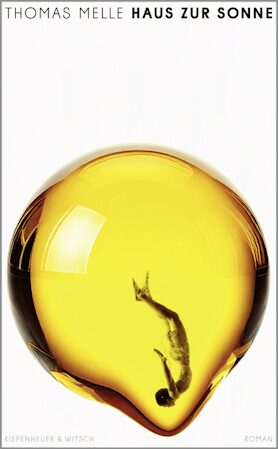
Thomas Melle
Haus zur Sonne
[House in the Sun]
- Kiepenheuer & Witsch Verlag
- Köln 2025
- ISBN 978-3-462-00465-6
- 320 Pages
- Publisher’s contact details
For this title we provide support for translation into the Polish language (2025 - 2027).
Sample translations
Pilot project in self-erasure
In 2016 he published Die Welt im Rücken (The World at My Back), a book that carried no genre label and was clearly an autobiographical account as well as a substanital work of literature. In interviews, Melle has compared the figure of the ‘madman’, a role he has ruthlessly claimed for himself, to that of a terrorist, someone who has dropped out of every social context, with no connection to an ordered everyday life and no place in any system of rules. And of course he is furious, furious at his own powerlessness in the face of the illness and at the reactions that come back at him. Die Welt im Rücken tells the story of a total loss of all ties and all material security. The single glimmer of hope lay in the idea that with the right medication, the illness, the bouts of depression, the paranoid surges and the delusions that made the patient see signs in everything around him might be kept more or less in check.
This was a mistake. Melle’s new book, published as a novel this time, is about that mistake and its consequences. The mania returns. The trigger, the first-person narrator tells us, was the award of the Nobel prize for literature to Peter Handke. The narrator publishes an article about the reactions on Twitter that followed. This article is real, Melle published it at the time in Die Zeit. In the novel we read: ‘I had written the article in three or four hours, just before a short holiday. The piece, published just as quickly, set off a secondary uproar in a debate that was already overheated, especially on social media. That is when it began. I felt misunderstood and wanted to sharpen my interpretation, to make another statement without backing away from my overall critique of Twitter as a medium. I looked at my phone too often during the short holiday, read stupid things, overwhelming things, attacks, and I was under stress.’
Melle, or his narrator, drops into a bottomless pit of persecutory delusions, a psychosis more destructive than ever before. The realisation: ‘I went mad again and stayed that way.’ In this state, the narrator discovers a leaflet in the job centre. ‘Can’t go on like this?’ it asks, advertising a ‘pilot project for improving your life, fulfilling your dreams, abolishing yourself’. This project is the titular Haus zur Sonne. The narrator applies for a place in the institution and is accepted. In this facility, which is funded with public money, the premise is roughly this: people who no longer wish to live check themselves in voluntarily. In simulations, intensely vivid dreams, they spend a while inside alternative stories, projections of how their lives might have gone. Who or what they might have been if they had been different, ‘healthy’, more capable of coping with life. They are shown the good life one more time, and then they are killed.
Haus zur Sonne is a euthanasia programme dressed in soothing language, a place with no way out once you are inside. After all, you chose to come. As a reader, you are taken once again through all the highs and the lows of an extreme consciousness that is bent on destruction. Without spelling everything out, the novel raises major ethical questions about how we deal with illness and with lives deemed no longer worth living. The fact that people themselves no longer see their own lives as something to be preserved tightens this spiral even further. Haus zur Sonne is a radical novel, and in the end, in its refusal to give in, also a deeply humane book.
Translated by Alexandra Roesch

By Christoph Schröder
Christoph Schröder, born in 1973, works as a freelance writer and critic, contributing to Deutschlandfunk, SWR Kultur and Die Zeit, among others.
Publisher's Summary
How much self-determination is possible when mental illness controls your life? What does someone who feels they have nothing left to lose truly long for? And what might ultimate happiness look like? Welcome to the “Haus zur Sonne,” an institution that is both a wish-fulfillment machine and an abolition apparatus. Here, people who are tired of life or terminally ill voluntarily enter this state-funded clinic to have every conceivable wish granted – before quietly departing from life. But do those who no longer want to live really want to die? Plumbing the depths of our longings and death drives, Thomas Melle offers a radical sketch of the human condition.
(Text: Kiepenheuer & Witsch Verlag)