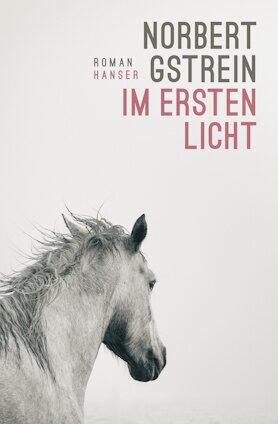
Norbert Gstrein
Im ersten Licht
[At First Light]
- Carl Hanser Verlag
- Munich 2026
- ISBN 978-3-446-28297-1
- 416 Pages
- Publisher’s contact details
Polish rights already sold.
Sample translations
The Machinery of War
Over the past few decades he has repeatedly written about war. But with his new novel Im ersten Licht (In the First Light), Norbert Gstrein has taken his writing to another level. As so often in Gstrein's work, the opening sentence introduces the novel's theme while generating tension of its own: "Adrian himself had not been to war, yet three times in the course of his life he had dealings with young men who had been to war, each of whom went on to shape the rest of his life for years to come." Adrian, the protagonist, is Adrian Reiter, and you could say that this is his story: born in 1901, the son of a postal official in the Salzburg region. His father takes an axe to the young Adrian's thigh, delivering the so-called “golden wound”, thereby sparing him from being sent to the First World War. Adrian becomes a grammar school teacher, threads his way through National Socialism in a mixture of naivety and opportunism, watches his marriage fail with detached indifference, spends the finest years of his life on various stays in England during the post-war decades, and, in 1988, finds himself in his final home beneath a picture of an angel with enormous wings. None of this would be inaccurate, and yet it takes a writer of Norbert Gstrein's calibre to turn these biographical facts into a work of literary art.
As ever with Gstrein, it is about the language, the long garlands of sentences in which he encloses his characters so elegantly that they become recognisable and enigmatic at the same time. Language, paradoxical as it may sound, is for the Austrian Gstrein always also an instrument for exposing the manipulative power of words. Adrian Reiter is a bystander to the currents of his age, someone who stands by and does not resist, through whom things flow and are thereby permitted to happen. In each of the novel's three long, tightly interwoven parts, Reiter becomes witness to some enormity. In the first, in their lakeside villa in Adrian’s home town a wealthy industrialist family conceals their own son, disfigured by war wounds and previously declared dead. This son of an English mother, Earnest, will, like almost all the villa's other inhabitants later on, take his own life. In the second part, it is Adrian Reiter's former pupil Martin Baumgartner who, infected by Adrian's enthusiasm for the cavalry, volunteers for the army and, home for Christmas leave in 1941, tells his old teacher of shootings in the East. In Adrian's memory, Baumgartner's account grows so blurred that he can no longer be sure whether his former pupil, whose pre-war biography Gstrein has modelled on that of the later Federal President Kurt Waldheim was an active perpetrator or merely a passive onlooker.
Adrian, spared from having to go to war himself by his father’s intervention, can seem quite unsettling in the indifference of his attitudes and perceptions. Apart from having his pupils write essays on absurd, Führer-glorifying topics at the dawn of the Third Reich, Adrian, the history teacher, had in essence done nothing. Or, more precisely, what he did during this period Gstrein leaves in the dark, and only one thing is certain: he offered no resistance. But is it a form of guilt to do nothing? Im ersten Licht is full of carefully composed, oppressive scenes and images that linger in the memory. Norbert Gstrein does not pass judgement on anyone. His world is not divided into victims and perpetrators. Adrian is a participating observer of history's calamitous course. He is part of the great machinery of war that never grinds to a halt. And which continues to this day. Could a novel possibly be more of its moment?
Translated by Alexandra Roesch

By Christoph Schröder
Christoph Schröder, born in 1973, is a freelance writer and critic who contributes to Deutschlandfunk, SWR Kultur, and Die Zeit, among others.
Publisher's Summary
Born in 1900, two world wars: the lifetime of a century full of beauty, tragedy and decisions
Norbert Gstrein offers us the entirety of a human life – although every existence is fragile in this novel that begins with a blow from an axe: Adrian’s father renders him unfit to fight in the First World War – perhaps even saves his life in so doing. The wonder of this story lies in the bull-headed, tender person who limps through eighty years of life from this point onwards. Adrian twice sees his whole world collapse, twice has dealings with young men who have had less luck than he has, and, in his old age, experiences an unhoped-for love story, despite being a man who was taught everything except how to love. How can one live in the shadow of war and killing? With its fearless examination of the past, "At First Light" raises this major question of our present day.
(Text: Carl Hanser Verlag)