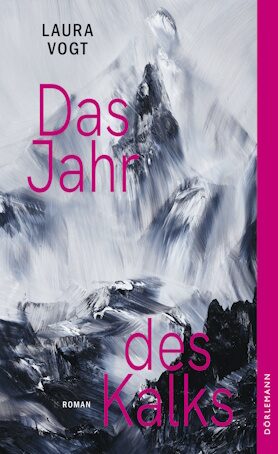
Laura Vogt
Das Jahr des Kalks
[The Year of Limestone]
- Dörlemann Verlag
- Zurich 2026
- ISBN 978-3-03820-186-1
- 192 Pages
For this title we provide support for translation into the Polish language (2025 - 2027).
Sample translations
The Stuff We’re Made Of
It takes a deep knowledge of the world to understand this and, for all its stylistic restraint, The Year of Lime, the fourth novel by Swiss writer Laura Vogt (born in 1989), is an extraordinarily wise and worldly book. The premise: first-person narrator, Alina, a writer and artist, has a studio only a few buildings away from the hospital where her Uncle Per is dying. This man, who has been more than an uncle to her, was diagnosed with cancer a year ago. Now Alina is waiting to hear from the hospital so that she can say goodbye to him. Per, her father’s brother, was there for Alina when her father left the family. Alina remembers holidays with him, hikes in the mountains, moments of closeness. And she takes stock of her adult life, as a wife and a mother of two.
All this may sound rather conventional but, in fact, the novel is anything but. Variations on the theme of lime and dust run through the narrative like a leitmotif: Alina’s father has left his family in the dust; Per, her uncle, awaits the fate of humans as decreed in Genesis: ‘dust thou art, and unto dust shalt thou return’; her grandfather was a chemical lab assistant and a stone carver, who devoted his life to minerals and the nature of rocks. In Vogt’s novel, everything is intimately connected: ‘Things come, things go. Animals live, animals die. Meanwhile, on land, in the sea, in lakes and rivers, deposits accumulate; material is consolidated, dehydrated and compressed to form layers of sediment.’
It is the buried matter hidden in the sediments of memory that Vogt’s narrator attempts to uncover. Alina signs up for a course in preservation at the dinosaur museum. ‘Preserving relics,’ she thinks, ‘maybe that’s all I’m good for at the moment.’ The Year of Lime is free of all sentimentality. It is a subtly written, tightly woven text that asks questions without spelling them out and feels its way towards possible responses rather than providing answers. In this open-ended exploration, there is great comfort.
Translated by Imogen Taylor

By Christoph Schröder
Christoph Schröder, born in 1973, is a freelance writer and critic who contributes to Deutschlandfunk, SWR Kultur, and Die Zeit, among others.
Publisher's Summary
A comforting book about coming to terms with grief
A young artist and mother has to say goodbye to her beloved uncle, who is dying. Inevitably she is reminded of her father, who left her family when she was a child. While dealing with this dual pain, she begins to take an increasing interest in limestone. After all, she always enjoyed going to the mountains with her brother.
By contrasting the abstract with something concrete, by uncovering fossils in limestone or visiting a lime kiln, she finds her own way of coping with her grief. In the process, she not only learns a lot about herself, but also about nature, and along the way, she forms lasting friendships. A novel – as poetic as it is wise – about transience, reconciliation, and the substance life is made of.
(Text: Dörlemann Verlag)