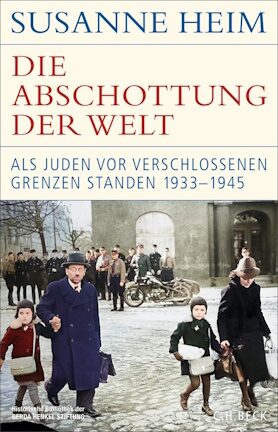
Susanne Heim
Die Abschottung der Welt
[The Sealing of the World]
- C.H.Beck Verlag
- Munich 2026
- ISBN 978-3-406-84301-3
- 384 Pages
- Publisher’s contact details
For this title we provide support for translation into the Polish language (2025 - 2027).
Sample translations
No place to stay, no place to go
The history of the escape and expulsion of the Jewish population of Germany has, for whatever reason, been less thoroughly researched than the history of their extermination. One expert on this complex topic is Susanne Heim, project director and editor of the sixteen-volume source edition The Persecution and Murder of European Jews by Nazi Germany, 1933-1945. Her new book is about the “walled-off world” that German Jews faced after the Nazi seizure of power. It was Germany that deliberately made it impossible for Jews to stay. And it was the rest of the world that frequently refused to let them in when they tried to leave. Hannah Arendt criticized this policy of closed borders as “a form of lawlessness, organized by the police.” Heim sees parallels to today’s refugee policies – in Europe, America and elsewhere. “How,” she asks, “will future historians judge today’s migration policies?”
Much of Heim’s book is dedicated to the dramatic experiences of Jewish refugees. There were notable differences between the fates of men and women, poor and rich, old and young, as well as those who left early and those who left late. With the outbreak of the war in 1939 the situation came to a head. Those who couldn’t go overseas were at risk of deportation. Heim takes a detailed look at the policies of host countries, where often enough homegrown anti-Semitism stood in the way of granting refugees asylum. Only gradually did an international refugee policy take shape in which plans were discussed, sometimes in the service of isolationist aims, to resettle Jews in Africa or Australia. On the other hand there were commendable initiatives like the Kindertransport, when the British Parliament permitted the admission of unaccompanied children in 1938. Even though the international community failed to establish a joint policy there were voices in this era that recognized the necessity of a multilateral refugee policy, one consequence of which was the founding of the United Nations High Commissioner for Refugees (UNHCR) in 1950.
In the end, however, it was not so much states as civil networks that enabled Jews to escape and survive. International Jewish organizations, most actively the American Jewish Joint Distribution Committee, were occasionally in a position to mobilize politicians and society to rally around their cause. The small steps taken by aid organizations at the time might seem modest when compared to the magnitude of the catastrophe that was the Holocaust. And yet the Jewish community succeeded in making its voice heard, especially in the United States and Britain. Which lobby nowadays, to recall the parallels noted by Heim, would be able to give our current refugee movements a voice?
Translated by David Burnett

By Christoph Bartmann
Christoph Bartmann was director of the Goethe-Institute in Copenhagen, New York and Warsaw. Today he lives and works in Hamburg as a freelance author and critic.
Publisher's Summary
When Jews Faced Closed Borders. 1933-1945
Susanne Heim has, for the first time, systematically examined the perfidious barriers erected by the free nations of the world against Jewish refugees. Her vivid account shows why so few managed to escape until the Nazi state banned emigration and organized mass murder.
Despite desperate efforts, most Jews failed to emigrate. With the Germans approaching potential refuge states closed their borders, tightening restrictions. The League of Nations and the US government tried in vain to coordinate responses. At the Évian Conference in July 1938, states and aid organizations discussed refugee admission — without result. The Nazis sneered: nobody wanted the Jews, so why should Germany?
Denied legal entry, refugees boarded unseaworthy boats, paid smugglers and took illegal routes to safety. Heim’s concise, gripping book is a landmark: never ever has international refugee policy and its catastrophic failure been described in such a comprehensive way. A necessary and disturbing read.
(Text: C.H.Beck Verlag)